
What Phnom Penh's Rainfall Pattern Means for Tanks
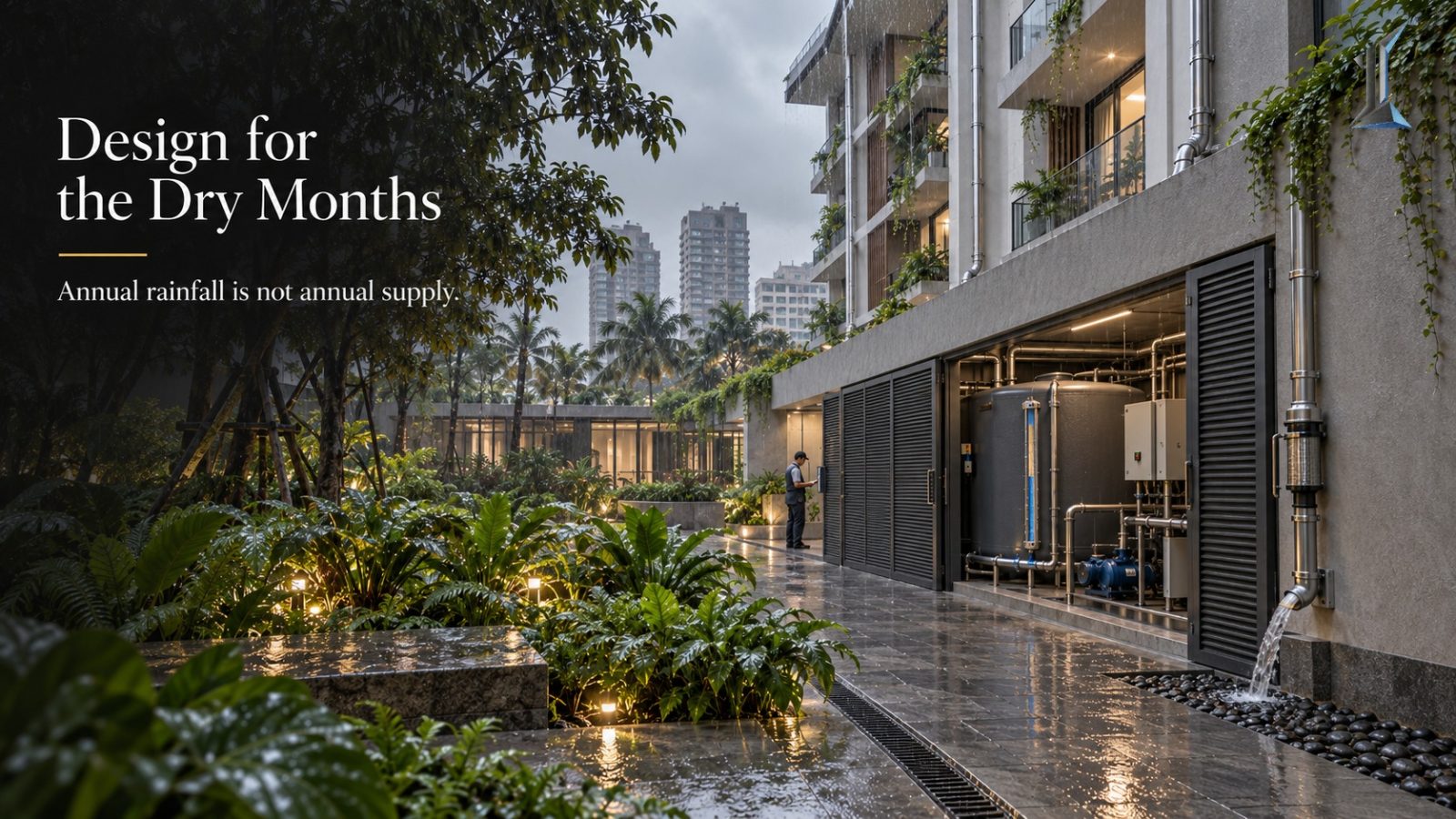
Phnom Penh averages close to 1,400 millimeters of rain a year, enough on paper to cover a mid-rise building's irrigation and toilet-flushing demand. The volume is not what decides whether a rainwater harvesting system works. The six-month gap between the wet season and the dry one is, and the tank sizing has to be built around it.
Phnom Penh receives close to 1,400 millimeters of rain in an average year. Spread evenly across the calendar, that volume would cover a meaningful share of a mid-rise building's irrigation and toilet-flushing demand. It does not arrive that way. Nearly all of it falls inside a six-month window, and the other six months receive almost nothing.
That distribution, not the annual total, decides whether a rainwater harvesting system in this city functions as a real source of supply or as an oversized gutter upgrade with no real function.
The math behind rainwater harvesting
The formula is short. Collectible volume equals catchment area multiplied by rainfall depth multiplied by a runoff coefficient that accounts for evaporation, splashing, and surface loss. A flat concrete roof deck, the standard finish on most mid-rise towers here, typically runs a coefficient between 0.75 and 0.85. A corrugated metal roof runs higher, closer to 0.90, because water sheds faster and less of it is lost to surface absorption.
Take a building with a 1,000 square meter roof footprint, a common scale for residential mid-rise in Phnom Penh. At 1,400 millimeters of annual rainfall and a coefficient of 0.8, the math returns roughly 1,120,000 liters a year, or a little over 1,100 cubic meters. On paper, that is enough to cover landscape irrigation, cooling tower makeup, and a meaningful share of toilet flushing demand for a building of that size.
The paper number is where most feasibility conversations stop. It is also where they should start asking the harder question.
What the calendar does to the number
Phnom Penh's wet season runs roughly from May through October. September is typically the wettest month, with rainfall in the range of 250 to 320 millimeters. February sits at the other end of the year, often recording under 15 millimeters for the entire month, and the dry stretch from November through April carries only a small fraction of the annual total.
A tank sized against the annual average fills fast in July and August and sits close to empty through January and February, exactly when dry-season irrigation and cooling demand tend to be highest. A system built around the yearly figure of 1,120,000 liters is, in practice, a system that has to survive on almost nothing for roughly five months of the year.
Sizing for the dry months, not the annual average
The question that decides tank size is not how much rain falls in a year. It is how much storage a building needs to bridge its driest consecutive stretch without falling back entirely on mains supply. That number is set by dry-season demand, not by wet-season supply.
A cistern built only to smooth out a single storm event needs a fraction of the annual yield, often sized in the tens of cubic meters. A tank meant to carry meaningful non-potable supply through five dry months needs to be sized against months of near-zero inflow, which changes the storage volume by an order of magnitude and moves the decision from a gutter detail to a structural and shaft-space allocation made at the brief stage, not added later.
First flush diversion belongs in the same specification line. The first several minutes of any storm wash roof debris, bird waste, and atmospheric dust into the collection line, and a diverter has to route that volume away from the tank before storage begins. Skipping it does not save money. It moves the expense into filtration and tank cleaning later, on a schedule the building does not control.
Stagnation risk in a warm climate
A covered tank in a Phnom Penh climate behaves differently than the same tank in a temperate one. Water sitting at ambient tropical temperature for weeks between storms is a favorable environment for algae growth and mosquito breeding unless the tank is fully sealed, vented through a screened overflow, and drawn down regularly rather than left static. This is a maintenance discipline, not a one-time installation detail, and it belongs in the building's operating manual from day one.
Where the certification credit actually lands
Certification pathways including EDGE and LEED credit rainwater harvesting toward a project's water reduction target, the same category that credits greywater reuse. The credit is calculated on demonstrated, realistic non-potable offset, not on the theoretical annual catchment figure. A submission built on the full 1,120,000-liter number, without accounting for five dry months of near-zero contribution, overstates the offset and understates the mains water the building actually needs to hold in reserve.
The honest version of this math is smaller than the marketing version. It is also the version that survives an audit.
What this changes at the brief stage
Roof drainage, downpipe routing, and tank or cistern placement are decided before the structural drawings are finalized, not after. A rainwater system retrofitted into a completed building means new penetrations through a roof slab that was not designed for them and shaft space that was never reserved. The same system, specified at the brief stage, costs little more than a line item in the plumbing package.
Phnom Penh's rainfall pattern does not make rainwater harvesting a poor idea. It makes it a seasonal supplement rather than a year-round source, and the sizing has to reflect that distinction rather than average it away.
The difference between a rainwater system that performs and one that becomes a maintenance liability is not the tank. It is whether the design accounted for the five months when the sky offers almost nothing.
Owners who ask this question before the roof plan is finalized tend to end up with a system that earns its space. Those who size against the annual average tend to end up with a tank that is full twice a year and empty the rest of the time.
At Imajineer, this is one of the calculations we run before the roof detail is drawn, not after. The conversation is available when it is useful.