
What Biophilic Design Actually Does
A single potted plant cleans almost no air. Most biophilic design is installed as a finish and sold as a feeling, while the performance it promises comes from daylight, orientation, ventilation, and views to real greenery. In a tropical climate, the difference shows up by year five, when a decorative green wall becomes a maintenance line and a working one keeps earning its place.
A single potted plant cleans almost no air. The studies that made planters look like purifiers were run in sealed laboratory chambers, and when researchers later modeled the numbers against a real room, the finding was blunt. To match the fresh-air delivery of a building's ventilation, a space would need somewhere between 10 and 1,000 plants per square meter of floor. A modest bedroom would vanish behind more than a hundred of them.
This is the quiet issue with most biophilic design. It is installed as a finish and sold as a feeling, and the performance it promises usually lives somewhere the planter cannot reach.
What biophilic design actually buys
Walk through a recently handed-over lobby and the biophilia is easy to spot. A living wall behind reception. Potted palms at the lift core. A framed courtyard the photographer loved. All of it reads as nature, and almost none of it is doing measurable work for the people who live upstairs.
Decoration is not worthless. A green wall in a sightline lowers perceived stress for the few seconds a resident looks at it, and that effect is real. The problem is the gap between what the image promises and what the system delivers. A resident told the building breathes expects cleaner air and a cooler apartment. A wall of ferns behind glass, on its own drip line, delivers neither.
The response the body actually has
The performance case for biophilia is stronger than the decoration case, and it comes from a different set of decisions. The most cited study in the field followed hospital patients recovering from the same surgery. Those with a window facing trees left roughly a day sooner than those facing a brick wall, and asked for fewer strong painkillers. Nothing was planted for them. They were given a view.
That pattern repeats across the research. Measured stress markers fall when people can see greenery, work near daylight, or hear water instead of traffic. Attention recovers faster in rooms with a view to something living. The mechanism is biological, and it responds to access, not ornament.
Biophilia is also broader than plants. Natural materials with visible grain, daylight that moves across a room through the day, sightlines that open onto something alive. These register the same way a garden does, because the body responds to natural pattern, not to foliage specifically. A stone floor that ages well and a window placed to catch a mature tree both qualify. A plastic planter under a downlight does not.
What year five looks like in a tropical climate
Phnom Penh raises the stakes on this distinction. Humidity sits above 80 percent for much of the year, and the monsoon runs for months. A vertical garden in this climate is a piece of wet infrastructure bolted to a wall, and it behaves like one.
The decorative version fails on a schedule. The irrigation clogs, a section browns, the substrate holds water against the structure, and by year five the wall that sold the building is a maintenance line nobody funded. A poorly detailed planting system also becomes a mold and leak path in exactly the conditions this climate guarantees. At that point the green wall has stopped being biophilia and become a defect.
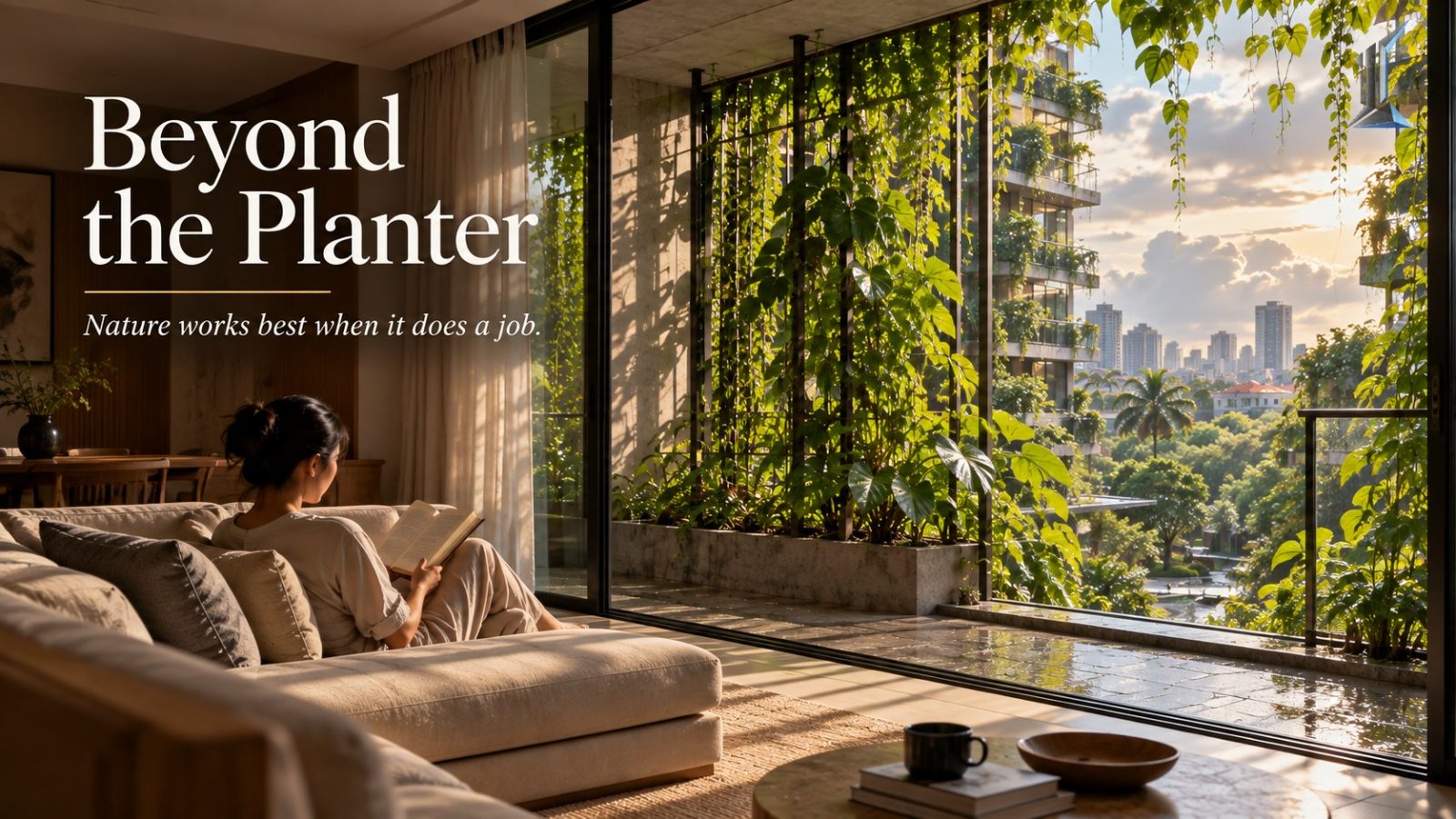
The performance version earns its place because it does a second job. A planted screen on a west facade is first a shading device, cutting afternoon solar gain before it reaches the glass. A green roof is first a thermal layer. Field measurements put the membrane surface under a green roof 30 to 40 degrees cooler at peak than a bare one, which roughly doubles the life of the waterproofing beneath it. The planting is real, and so is the reason it is there.
Designing biophilia as a system
The test worth applying is simple. Every biophilic element has to survive being asked what it does when no one is looking at it. A courtyard that pulls daylight into interior units and drives cross-ventilation is working at 3 a.m. A lobby planter is not.
That reorders the whole discipline. Orientation and window placement come first, because a view to greenery only counts if the unit has the window to receive it. Daylight access is settled before decoration is chosen, because the circadian benefit comes from the light, not the leaves. Ventilation paths are drawn so the building can breathe without a fan, which does more for air quality than any planter in the catalog. Only then do the plants go in, sized and irrigated as the system they are, with the maintenance budget written down before handover rather than discovered after it.
Biophilic design fails when it is treated as a surface and works when it is treated as a system.
An owner evaluating a building can test this in one question. Ask what each green element does for the apartment on a shut day in the monsoon. The honest answer separates the projects designed for the resident from the ones designed for the brochure, and it is a better guide than the number of living walls in the lobby.
At Imajineer, the planting is placed after the orientation, the daylight, and the airflow are settled, because those are what carry the benefit. The conversation is open when it is useful.