
How Tropical Surface Materials Age Over Time
Standard cement grout absorbs up to 25 percent of its weight in water. The porcelain tile beside it absorbs under half a percent. That gap, not the material name, decides how a surface ages in tropical air. A specification-level look at how stone, terrazzo, and tile behave in Phnom Penh humidity, and the one number worth reading before you sign off on any of them.
Standard cement grout absorbs 20 to 25 percent of its weight in water. The porcelain tile it frames absorbs less than half a percent. Two materials sit in the same square meter of floor, and the joint between them is roughly forty times thirstier than the surface it holds in place.
That gap is the whole story of how surface materials age in tropical air. A building in Phnom Penh lives in 70 to 80 percent relative humidity for most of the year, with monsoon rain, hard sun, and airborne grime working on every exposed plane. Stone, terrazzo, and tile all meet that air. What decides which one still looks dignified in year fifteen is not the family name on the drawing. It is a number that rarely appears on the sample table.
The number that governs a tropical surface
Water absorption, measured as a percentage of dry weight, is the master variable for any hard mineral surface. It predicts staining, biological growth, and the speed at which a surface starts to hold what the air deposits on it. The lower the number, the slower the surface ages.
Ceramic tile is sorted by exactly this figure under ISO 10545-3. Porcelain sits at 0.5 percent or less and is called impervious. Above that, the classes run from vitreous at 0.5 to 3 percent, to semi-vitreous at 3 to 7 percent, to non-vitreous above 7 percent. The word porcelain on a box is a claim. The absorption test report is the fact, and a specifier who cannot see one should treat the label as a suggestion.
Stone is a chemistry question before it is a hardness one
Natural stone splits into two groups that behave nothing alike in tropical conditions. Siliceous stones such as granite and quartzite are built from quartz and feldspar, absorb under 0.4 percent, and are chemically stable. Calcareous stones such as marble, limestone, and travertine are built from calcite, and calcite reacts with acid.
This matters more than hardness. A sealer fills the pores and stops a spill from staining, but it does nothing against etching, which is a chemical attack on the surface minerals themselves. In a humid lobby cleaned with the wrong product, or exposed to the mild acids that ride in on rain and dust, a polished calcareous stone slowly dulls no matter how well it was sealed. The decision inside the stone family is therefore an exposure decision. Siliceous stone earns its place in wet and high-touch zones. Calcareous stone belongs where the chemistry it meets can be controlled.
Terrazzo is two materials wearing one name
Terrazzo is a binder holding aggregate chips, and the binder is the entire question. Cement terrazzo uses a Portland binder, runs 30 to 70 millimeters thick, is porous enough to need resealing every one to three years, and tolerates sun, rain, and exterior use. Epoxy terrazzo uses a resin binder, runs about 6 to 10 millimeters thick, cures non-porous and stain-resistant, and fades under direct sun, which rules it out of any space the tropical light reaches.
Same chips, two different buildings. A spec that says only terrazzo has not made a decision yet. The right reading is by placement. Epoxy indoors, where its low absorption and seamless surface do their best work. Cement where the surface has to face weather. One detail travels with both. The decorative chips are often marble, which means the surface still carries calcite, and still asks for neutral cleaners for the same reason polished marble does.
Tile is three tests pretending to be one
A tile carries three separate ratings that people routinely collapse into one. The PEI rating grades the glaze against surface wear. The absorption group grades the body against water. The wet slip rating, given as a DCOF value or an R number, grades the surface against a foot on a wet floor. A strong score on any one of these says nothing about the other two.
Even with all three read correctly, the assembly usually fails somewhere else first. Cement grout absorbs 20 to 25 percent water, which makes the joint the moisture pathway through an otherwise impervious floor. Water reaches the setting bed, sits in the assembly in humid air, and returns later as discoloration, mineral bloom, or a dark line that will not scrub out. Epoxy grout closes that pathway. The tile can be flawless and the floor can still age at its joints.
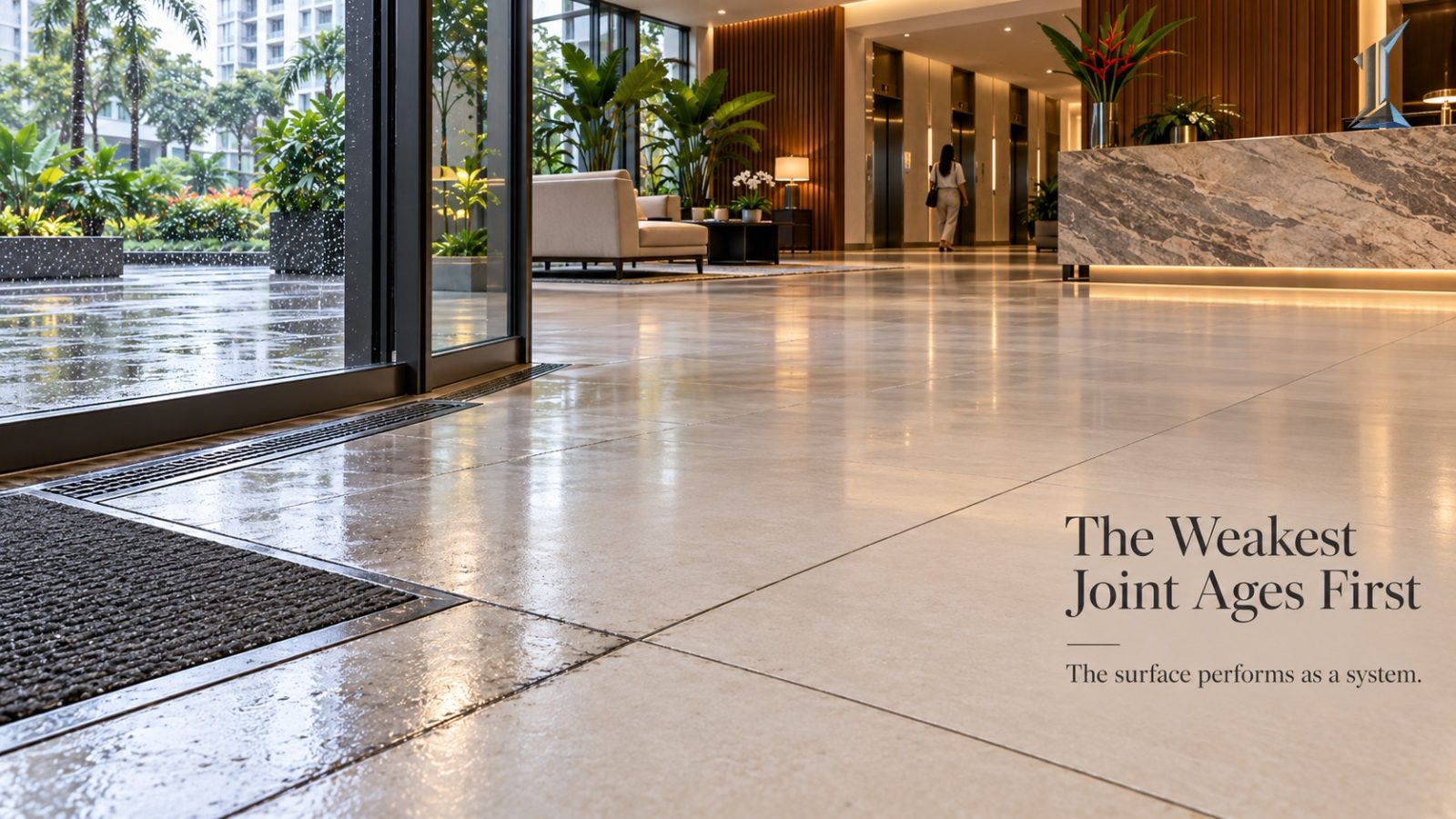
The surface is a system, and it ages at its weakest joint
Across all three families, one rule holds. A hard surface ages at the rate of its most absorbent component, not its headline material. An impervious porcelain floor set in thirsty grout ages like the grout. A marble lobby cleaned with an acidic product ages like the acid. A terrazzo floor is only as stable as the binder nobody specified.
Read that way, the three families stop being a style choice and become a set of numbers matched to a set of exposures. Absorption matched to humidity and wet contact. Chemistry matched to the cleaning regime the building can actually sustain. Binder and grout matched to the sun and rain the plane will meet. None of this is exotic, and all of it is decided long before a single surface is installed.
A hard surface does not age by its name. It ages by its most absorbent component and its least stable chemistry, both of which are settled on the specification sheet, not on the site.
Owners who read the absorption figure, the binder, and the grout before signing tend to walk a lobby that still holds its dignity in year fifteen. The work is quiet, it happens at the sample table, and it almost never looks urgent at the time.
At Imajineer, the sample table is where these numbers get settled, one exposure at a time, before the first surface is drawn. The conversation is open when it is useful.