
The Construction Administration Phase and What It Protects
Construction administration is the last phase in an architect's contract and the first one owners try to remove. It runs the full length of construction and protects four things at once: the owner's money, the specification, the concealed work, and the record of what was actually built. Cutting it saves a line on the first invoice and costs a multiple of that later.
The construction administration phase sits at the end of an architect's contract and is usually the first thing an owner tries to remove. It runs the full length of construction, from the day the contractor mobilizes to the certificate of substantial completion, and it carries roughly a fifth of the design fee. It is also the only phase where someone holding the drawings is standing on the site while the building is actually being built.
The phase is widely misread as supervision. It is not. The architect during construction administration does not run the site, does not direct the workers, and does not control the contractor's schedule or methods. The role is narrower and more exact. It is to confirm that the building going up matches the building that was designed and specified.
What the construction administration phase covers
The work is unglamorous and continuous. Reviewing shop drawings and material submittals before anything is ordered. Answering requests for information when the drawings meet a field condition no one anticipated. Walking the site on a set cadence to observe the work in progress.
Then the money. The architect certifies the contractor's payment applications, confirming that the work billed for is the work actually in place. At the end come the punch list, the final observation, and the certificate that the building is complete enough to occupy. On a mid-rise residential project this phase can run eighteen to twenty-four months, longer than every design phase combined. The phase most often requires only regular site observations on smaller projects and a full-time field team on large institutional ones. Archtoolbox
What it protects: the money
Payment certification is the quiet center of the phase. Without it, an owner pays against the contractor's own account of progress, with no independent read on whether the concrete billed this month is the concrete in the ground.
The exposure is not abstract. A Construction Industry Institute study put the cost of rework from poor quality in commercial construction at around five percent of total project cost. The largest drivers are late owner changes and design errors caught in the field rather than on paper. The phase that catches them before they are buried is this one. IRMI
What it protects: the specification
The second thing the phase protects is the specification, and this is where the money and the lifecycle meet. During construction a contractor will propose substitutions, an equivalent product offered in place of the one specified. Some are genuine equals. Some are quietly lesser, and the gap does not show for years.
A sealant rated for fifteen years in a temperate catalog compresses to about seven years of real service in Phnom Penh's heat and humidity. If a lower grade is swapped in without review, the owner inherits a resealing cycle they never agreed to. Submittal review during construction administration is the checkpoint where that swap gets caught or waved through.
What it protects: the concealed work
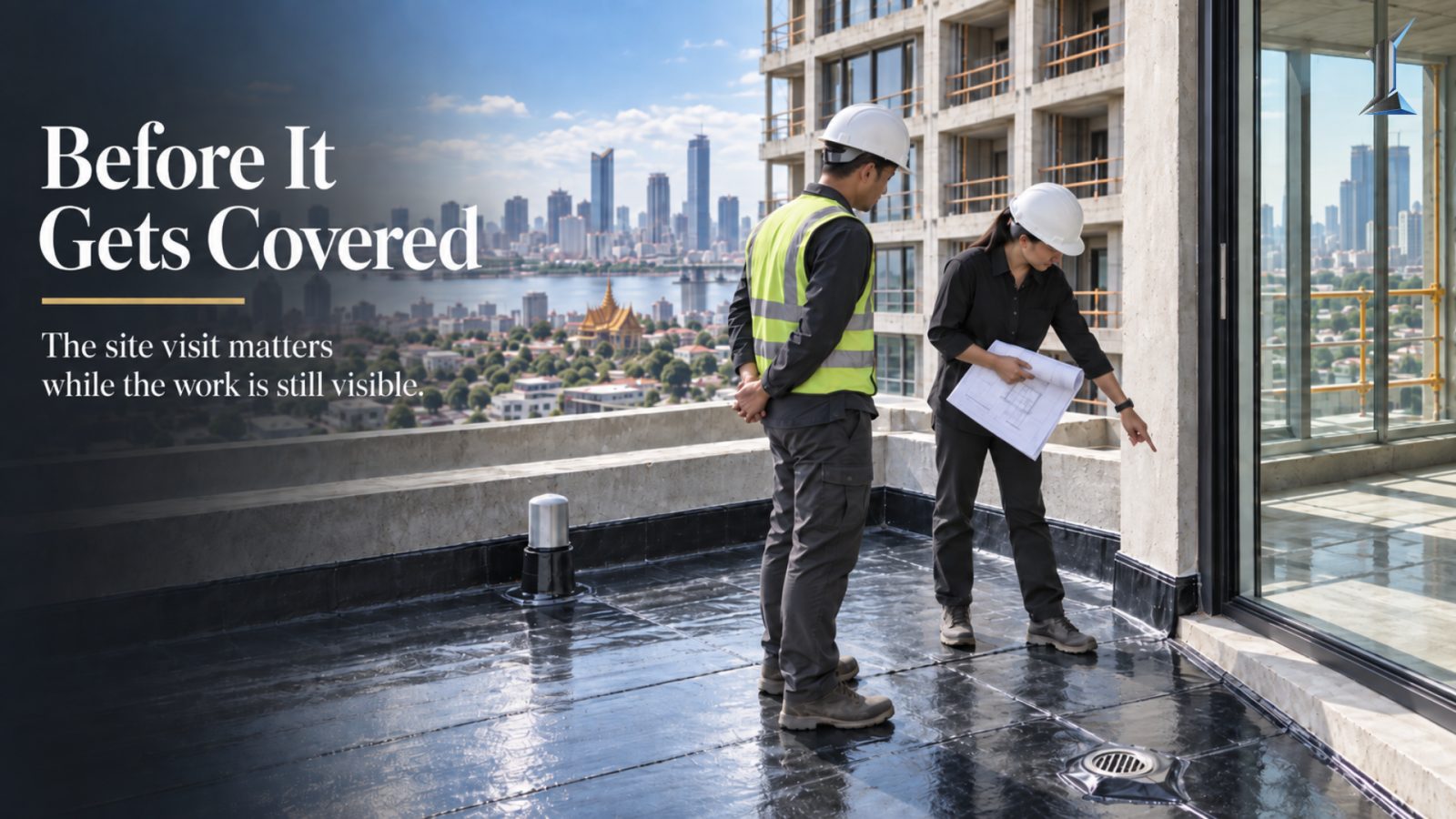
Much of what decides how a tropical building ages is sealed inside it. Waterproofing membranes, joint details at every facade penetration, drainage falls that have to be right to the millimeter. These are covered over as the work proceeds, and once the tile is set and the ceiling is closed, the only remaining evidence is whether the work was done correctly.
The value of a site visit is almost entirely a function of timing. One observation walk the week a podium membrane is being laid is worth more than a dozen walks after it is buried. The phase protects the building by putting a trained eye at the moment of closure, which is the one moment the work can still be seen. What was missed there does not announce itself until the second or third wet season.
What it protects: the record
The least discussed protection is the record. Construction administration closes with an as-built set, a corrected drawing package showing what was built rather than what was drawn. Every later renovation, every leak investigation, every system upgrade depends on that record being accurate.
A building handed over without a reliable as-built set has to be reopened and rediscovered each time something needs fixing. A membrane replaced during a renovation twenty years out already costs a multiple of the first install. The first question the contractor asks is what is behind the wall, and the answer should not be a guess. Across a service life of forty years and more, that document governs the cost of every intervention.
Construction administration is the phase that verifies the building on paper became the building on the ground. Everything before it is intention. This is the phase that checks the intention held.
Owners who keep this phase intact tend to spend less time, and far less money, correcting a building after they have already paid for it. The saving from cutting it is visible on the first invoice. The cost of cutting it arrives quietly, usually after the warranty has closed.
At Imajineer we treat construction administration as the completion of the design rather than a service to be traded away, because a drawing only protects a building if someone confirms it was followed. The conversation is open when it is useful.