
Proof Over Promise: What a Batch Number Does That an Adjective Cannot
Consumers discount claims and reward specifics. A scannable batch record is worth more than a shelf of premium adjectives, because it is the one thing a competitor cannot copy by rewriting a label.
Every premium food label in Southeast Asia makes roughly the same promises. Natural. Pure. Traditional. Finest quality. The words cost nothing to print, which is precisely why they persuade nobody. A claim that any competitor can copy onto their own label by close of business tomorrow carries no information, and consumers have learned to read it as noise.
What survives that discount is specificity. Not a better adjective, a verifiable fact.
The structural gap in a commodity category
Cambodian honey is a useful category to examine because the failure mode is so consistent. Most brands in the market declare no origin beyond the country. They document no batches. They position on the phrase "natural honey," print bright commodity packaging, offer no quality proof layer, and then compete on price, because price is the only variable left once every other signal has been surrendered.
The gap is not product quality. Plenty of that honey is excellent. The gap is that nothing about the packaging allows a buyer to tell the excellent from the mediocre, so the category collapses into a price contest that punishes the careful producer hardest.
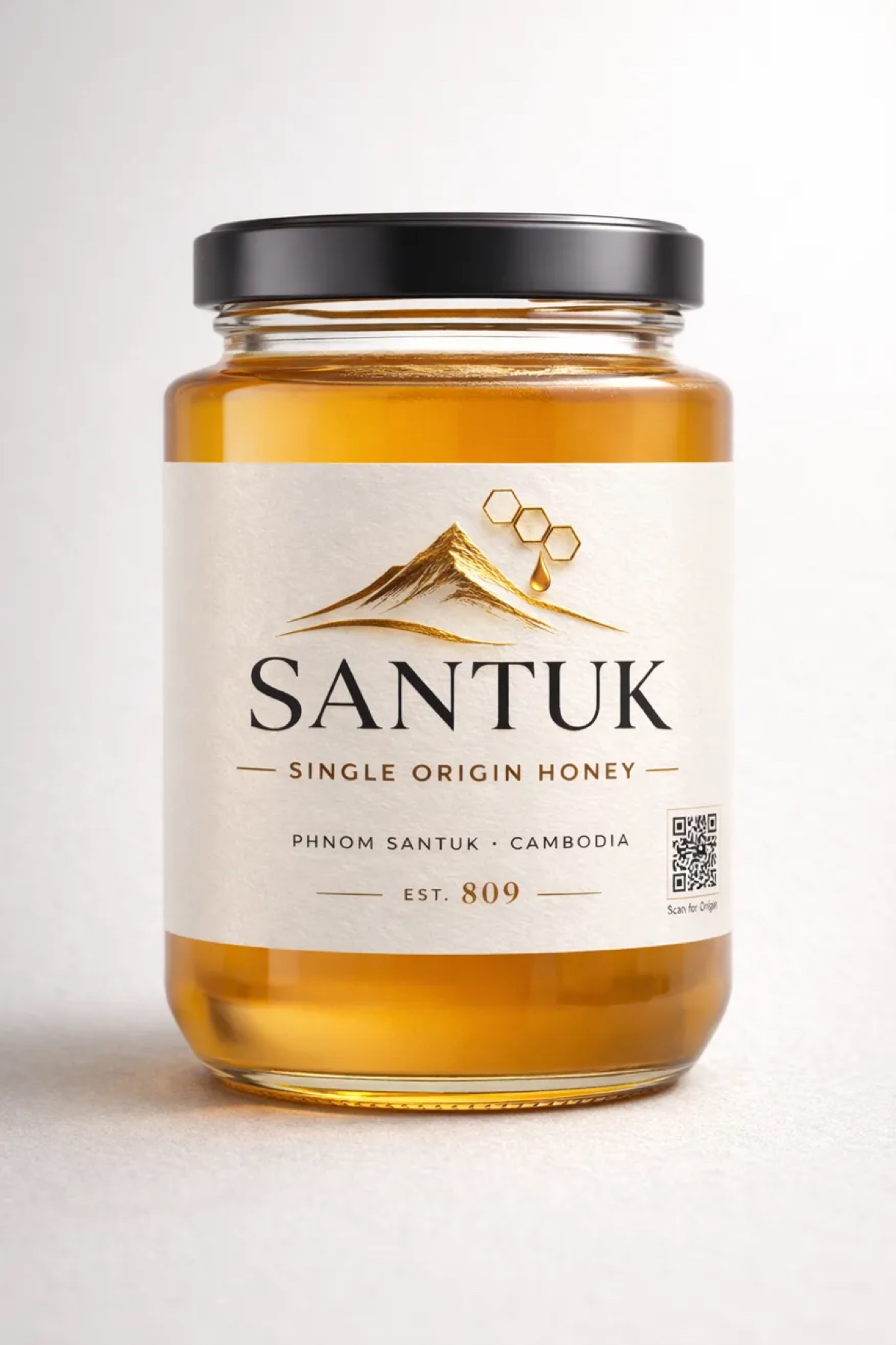
Santuk was built to occupy that gap, and the mechanism is a batch identifier that resolves to a real record.
What the format encodes
The batch ID on a Santuk jar reads STK-26-CB-01. Four segments, each carrying operational meaning:
- STK is the brand code.
- 26 is the harvest year.
- CB is the flora source, cashew bloom, which changes with the seasonal window.
- 01 is the sequence number within that harvest.
Scan the code on the label and the origin record for that specific batch opens: harvest window, apiary location, processing date, packaging date, and moisture percentage. Every jar traces back to one mountain, one harvest window, one declared source.
This is wine logic applied to honey, and the borrowing is deliberate. The specialty honey category worldwide has taken its credibility framework from wine and single-origin coffee, because those categories solved the same problem decades earlier. Appellation becomes declared region. Vintage becomes harvest window. Varietal becomes flora source. Winery profile becomes beekeeper profile. Lab certification becomes a moisture reading.
Why moisture is the most underrated line on the page
Of everything in the record, the moisture figure does the most work per character. The international threshold for stable, non-fermenting honey sits below 18.5 percent. A refractometer costs very little and takes seconds to use. Publishing that number per batch does three things at once: it proves the producer is testing, it gives a technically literate buyer a hard specification to evaluate, and it quietly signals that anyone not publishing it may not be measuring it.
That is the whole shape of a proof system. It converts an operational discipline the producer already practices into a customer-facing asset that competitors cannot fake without adopting the same discipline.
The non-negotiable that makes it work
A proof system has exactly one fatal failure mode: a QR code that resolves to nothing, or worse, to a page contradicted by what is in the jar.
Do not claim what you cannot reliably log. One false batch page destroys the entire proof structure, and it destroys it retroactively.
This is why the system is built in stages rather than launched complete. Stage one is a batch-level page: one QR per batch, not per jar, a landing page carrying the harvest data, built on a content management system and a QR generator. Low technical cost, immediately credible. Stage two adds unique per-jar codes that confirm authenticity and log the first scan, which requires a database and anti-counterfeit logic. Stage three logs the supply chain as a timeline: harvested, extracted, bottled, distributed. Stage four opens a transparency portal with seasonal bloom updates and an archive.
No stage advances until the previous one is operationally consistent. A brand that jumps to stage three and cannot maintain the event logging has manufactured a liability, not a differentiator.
What it does to pricing
Documentation is what makes a premium price defensible rather than aspirational. Santuk's suggested retail sits at twelve to eighteen dollars for 250 grams and twenty-two to thirty-two for 500 grams, against commodity honey selling at a fraction of that. The multiple is not justified by better marketing. It is justified by a stack of specifics: a single declared origin rather than a provincial blend, a batch ID and scannable proof, a lab moisture reading, premium packaging with a matte lid, a named beekeeper, and limited seasonal production.
Strip any one of those out and the price becomes harder to hold. Strip the proof system out and the brand is back to competing on adjectives.
The transferable principle
This is not a honey technique. It is the answer to a question every product brand has to face: what is the concrete thing a skeptical customer can point to?
For an agricultural product it is origin and batch data. For a processed food it may be a named facility and a sourcing chain. For skincare it is ingredient transparency and a documented formulation standard, which functions exactly the way a batch record does, giving the customer something to trust beyond the label copy.
The test is the same in every category. If the client cannot prove it operationally, it does not go in the brand. Not because the claim is necessarily false, but because an unprovable claim is indistinguishable from every competitor's unprovable claim, and the category has already taught consumers to ignore all of them.