
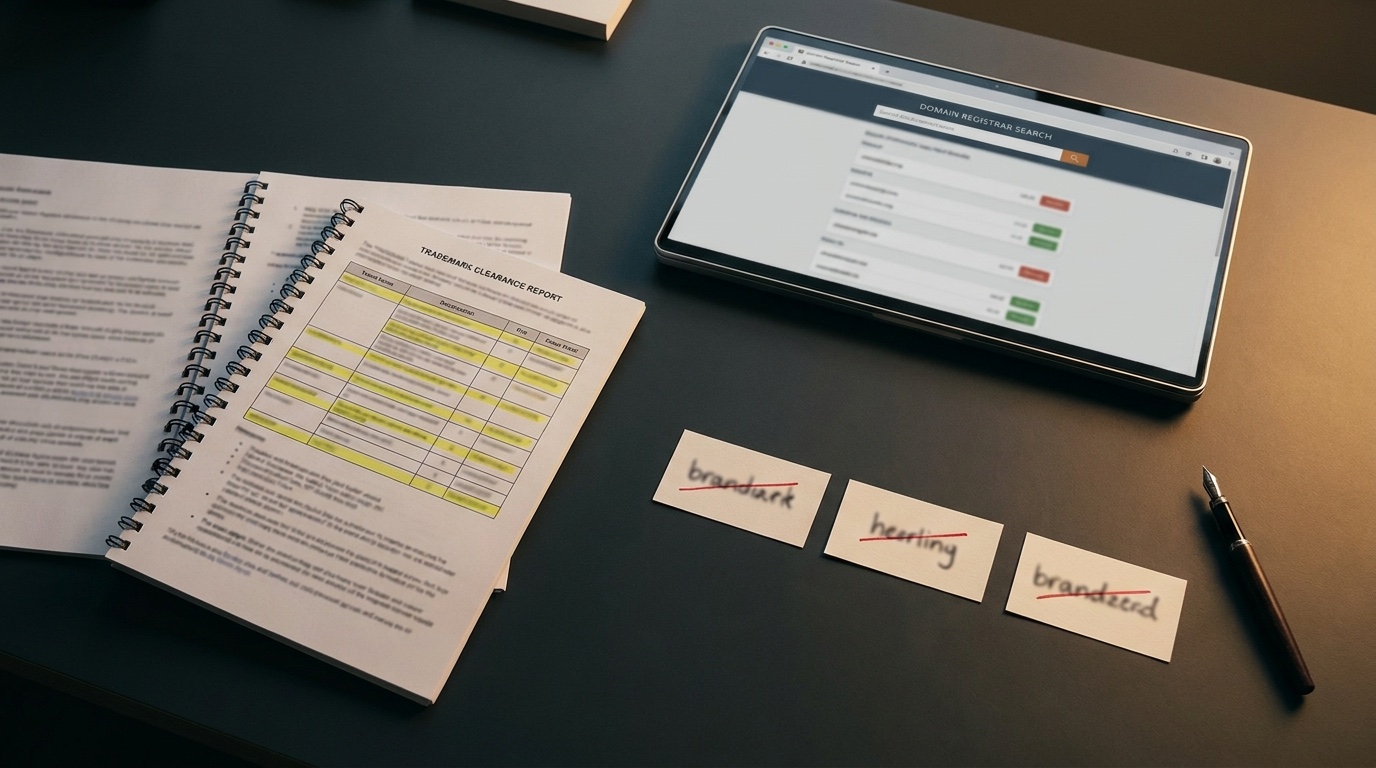
The Clearance Gate: Three Searches That Happen Before a Single Sketch
A name that fails trademark, search, or handle clearance is disqualified no matter how much the client loves it. Running the gate first costs a week. Running it late costs the brand.
The most expensive mistake in product branding is not a bad logo. It is a good logo attached to a name that cannot be owned. By the time that problem surfaces, the client has usually approved an identity, ordered label stock, registered a domain that half matches, and told their distributor the launch date. Unwinding it costs more than the entire identity fee.
So the sequence is fixed. No name advances to design until it clears three searches and a handle check. A name that fails is disqualified regardless of how well it tested in the room, how much the founder likes it, or how good it looks set in the display face.
Criteria before searches
Searching is the second step. The first is a filter that removes candidates before anyone spends a dollar checking them.
A name has to be spellable on first hearing. If a customer hears it in a shop and cannot type it into a search bar correctly, the name has built a permanent friction tax into every word-of-mouth referral the brand will ever earn. It has to survive the target languages: an export-facing food brand carries its name into French, Japanese, and Mandarin retail conversations, and a phonetic accident in any of them is discovered too late by definition.
It has to be short enough to own, ideally under twelve characters, because the same string has to sit inside a URL, a logo lockup, a social handle, and a jar label without truncating. And it has to signal trust in its own category. Distinctive is good. Confusing is not.
Santuk passed this filter on the strength of its referent. The brand is named for Phnom Santuk, the mountain the honey is harvested from. Six letters, one syllable pattern, spellable, and it carries the entire origin claim inside the word. The name is the positioning.
Search one: the trademark register
Every surviving candidate goes through a USPTO TESS search before anything else. The exact wordmark, then phonetic equivalents and common misspellings, then the relevant International Class for the category. Food products sit in Class 29 and 30, cosmetics in Class 3, apparel in Class 25. A name is only conflicted within its class, which is why a beverage brand and a software company can share a word without either being wrong.
The decision rules are unambiguous:
- A live registration in the same class, held by another entity, disqualifies the name. There is no negotiation step.
- A pending application in the same class gets flagged for legal review before any further work.
- An abandoned mark with a similar fact pattern is noted, and the history is disclosed to the client.
- Clear means documented as clear, then advanced.
One caveat is worth stating in writing every time: running a search is not giving legal advice. We document findings and flag risk. The client retains trademark counsel for registration and legal clearance. Any brand studio that blurs that line is exposing both parties.
Search two: what the market already thinks
A name can be legally available and commercially dead. The Google pass runs four queries: the name alone, the name plus the category, the name plus "brand," and the name plus "company" or "reviews."
What disqualifies a candidate is an existing operator in the same or an adjacent category. What gets flagged is subtler: negative press attached to the word, an active social account holding the handle, a marketplace listing that will outrank the client for their own name, or a domain squatter pricing the .com above two thousand dollars. That last one is a budget line, not a veto, but the client decides with the number in front of them.
Search three: the digital footprint
This runs simultaneously with the Google pass, never after it. The .com is the hard requirement. A .co is a short-term fallback for a direct-to-consumer brand with a documented plan to acquire the .com later. A country domain works for a market-specific brand with no export ambition, which for a Cambodian premium food product is almost never true.
Two rules have no exceptions. Domains never carry hyphens. Domains stay under fifteen characters including the extension.
Handles get checked across Instagram, TikTok, YouTube, Facebook, X, and Pinterest in one pass, and the standard is exact alignment or within one character of the domain. A brand whose handle differs per platform is paying a discoverability tax forever, and it compounds every time someone tries to tag them.
The matrix that goes to the client
Three candidates minimum, evaluated in a single table: criteria met, USPTO result, Google result, .com status and acquisition cost, handle availability, and a decision of proceed, hold, or disqualify. The client sees the full grid with a recommended primary and a recommended backup.
A name is not chosen in a meeting. It is the last candidate standing after the gate.
That framing matters more than it sounds. When the matrix is presented before any visual work exists, the conversation stays about ownability. Present the same matrix after the client has seen a beautiful logo and the emotional cost of disqualification will start bending the risk assessment.
The case for running it on concept work too
The Kampot pepper engagement is still in concept development precisely because the naming problem is unsolved. Kampot pepper holds a Geographical Indication, which places it in the legal company of Champagne and Parmigiano-Reggiano. The origin is protected. The word "Kampot" is therefore descriptive of a protected region rather than ownable as a brand, and the marketplace is crowded with products using it generically.
That is a naming brief, not a naming failure. The eventual name has to be ownable, phonetically accessible in English, French, and Japanese, and it has to signal premium origin without leaning on a geographic descriptor already diluted by inferior product. Design work does not begin until a candidate clears the gate. The client knows that from week one, and the timeline reflects it honestly.
What the gate actually buys
A week of searching, sometimes two. In exchange: no rebrand at month eighteen, no cease and desist letter after the first export order, no domain hostage negotiation, no handle mismatch across six platforms, and no conversation in which a founder learns their name belongs to somebody else.
That is not a compliance exercise. It is the cheapest insurance available in the entire brand development process, and it is the only step where the cost of skipping it grows every single week that follows.