
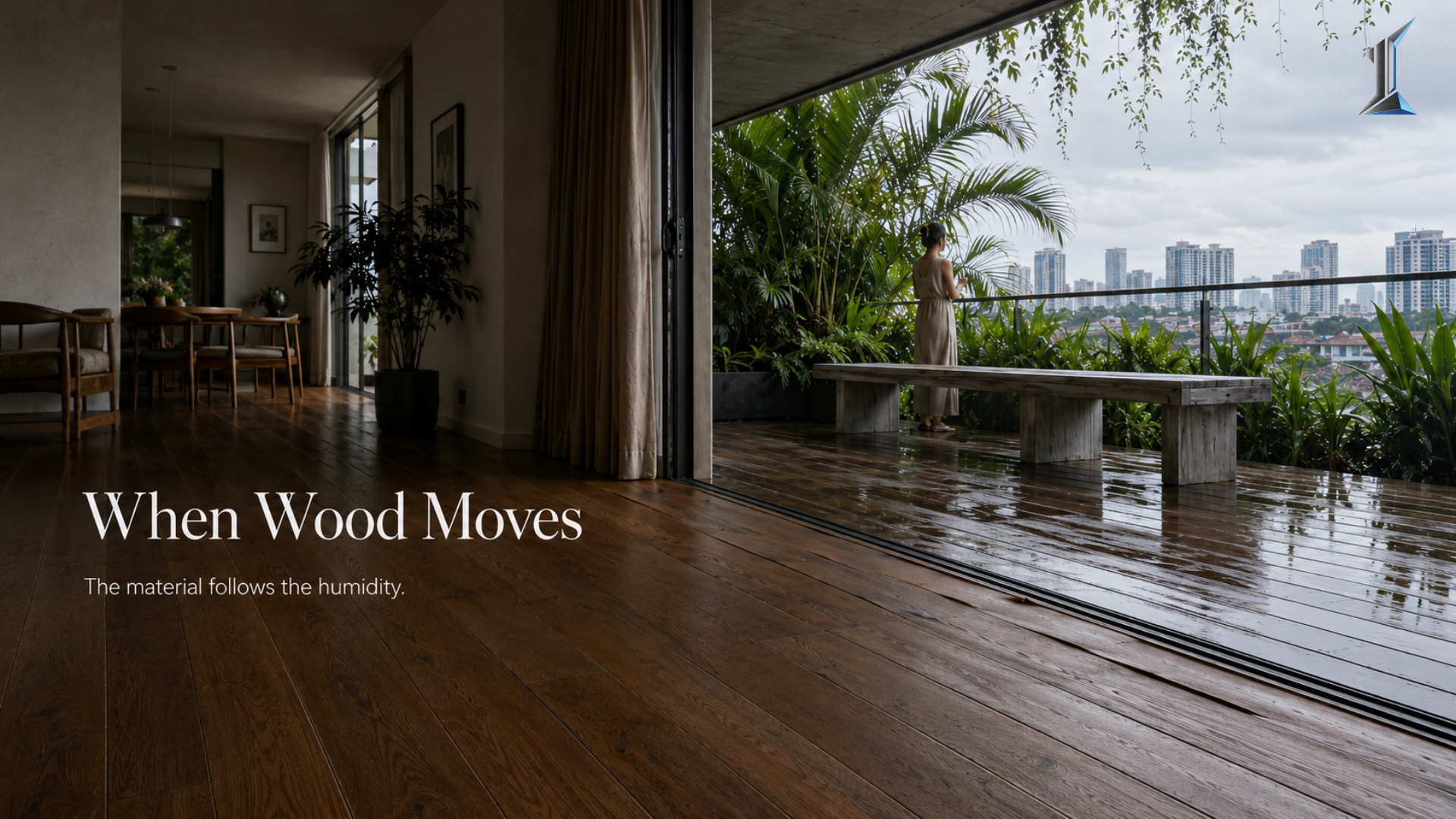
Wood in Tropical Buildings: When It Works, When It Warps
At 80 percent relative humidity, kiln-dried wood absorbs moisture until it buckles. The failure is almost always a specification problem, not a material one. This piece explains the EN 350 durability hierarchy, the placement logic, and the acclimatization step most builders skip.
A piece of kiln-dried hardwood flooring leaves the mill at 6 to 8 percent moisture content. In a climate-controlled warehouse, it stays there. Install it in a tropical building in Phnom Penh, where relative humidity runs between 70 and 80 percent year-round, and that wood will absorb moisture from the surrounding air until it reaches equilibrium with that air. At 80 percent relative humidity, that equilibrium point sits at roughly 16 percent moisture content. The floor that arrived flat and tight will cup, gap, and buckle within a single monsoon season, not from material failure, but from a specification decision made without the local humidity on the table.
The failure is misread as a material failure. It is almost always a specification failure.
What humidity does to wood in tropical buildingsWood is hygroscopic. It absorbs and releases moisture continuously until its internal moisture level matches the surrounding air. That balance point is called the equilibrium moisture content, and it moves directly with relative humidity.
For a building in Phnom Penh at 70 to 80 percent relative humidity year-round, interior wood will equilibrate at 14 to 16 percent moisture content. Standard kiln-dried flooring arrives at 6 to 8 percent. The gap between where the wood starts and where it will stabilize is 6 to 10 percentage points. Each percentage point of moisture increase in a flat-sawn board produces dimensional movement across the width of the plank. Across a run of flooring, that movement becomes buckling. At joint lines, it becomes cracking. At the surface, it creates the conditions under which mold can establish, surface mold has been documented to grow on exposed wood above 16 percent moisture content, which is precisely where unacclimatized timber will land in this climate.
This is physics, not an indictment of wood as a material. It is the case for understanding what you are specifying before you specify it.
The species hierarchy
The EN 350 standard ranks timber durability from Class 1 (very durable) to Class 5 (not durable). Teak and ipe fall into Class 1, while species like larch and cedar are considered Class 4. Pine and spruce sit at Class 4 to 5, offering almost no natural resistance to decay or insect attack in exposed tropical positions without active chemical treatment.
For exterior applications, teak's key advantage is dimensional stability. Its tangential-to-radial shrinkage ratio of approximately 1.5:1 means the wood moves predictably and minimally across seasonal moisture cycles, translating directly to fewer joint failures and more consistent gap maintenance over time. Merbau, native to Southeast Asia, carries comparable durability credentials. With a Janka rating of 1,925 lbf and a seasoned density of approximately 850 to 860 kilograms per cubic meter, merbau is a favorite in Southeast Asia because of its natural resistance to decay and superior strength. For decking applications, merbau is long-lasting and weather-resistant, with an expected lifespan of 25 to 30 years under tropical conditions.
A Class 4 softwood in the same exterior position, regardless of finish coating, will begin to degrade visibly within three to five years under direct monsoon exposure. The coating delays the process. The outcome is determined at the specification stage.
For sourcing, Class 1 tropical hardwoods are available with FSC certification, which confirms responsible forest management. That credential matters for buildings pursuing LEED or EDGE points on materials, and for owners who plan to hold the building long enough to care about supply chain reputation.
Interior versus exterior: the placement rule
The placement question is more important than the species question, and both matter more than the finish applied afterward.
Wood installed in air-conditioned interiors operates in a fundamentally different humidity environment. A well-maintained residential unit in Phnom Penh can hold interior humidity at 50 to 60 percent, a range at which a Class 2 to 3 hardwood will perform for fifteen years with routine maintenance. The same wood placed in an open corridor exposed to monsoon splash will begin to cup within a single rainy season.
The discipline is matching species class to exposure level before the specification sheet is agreed. Class 1 or Class 2 hardwoods for exterior and semi-exposed positions. Climate-controlled interiors can accommodate Class 2 to 3 species, provided the kiln-drying and acclimatization protocols are observed. No softwood in any exposed position. Wood in wet areas, planter liners, outdoor seating surfaces, uncovered soffits, carries a scheduled maintenance commitment, and that maintenance cycle should be built into the reserve from day one rather than discovered at year three.
This framework is not complicated. It is applied infrequently, which is why wood failure in tropical buildings is as common as it is.
The acclimatization step most projects skip
Even the correct species will fail if it is not acclimatized to site conditions before installation.
Timber delivered to a tropical construction site begins absorbing moisture from the air immediately. A board installed before it has stabilized to the local equilibrium moisture content will continue absorbing after the floor is down, producing the same cupping and gapping described above. The standard protocol calls for timber to be stored on-site, in the installation environment, for a stabilization period before cutting and fitting, long enough for the moisture content to move toward the local equilibrium. In Phnom Penh's humidity range, that stabilization period is a technical requirement. Treating it as a scheduling convenience produces a different floor.
The moisture content at the moment of installation is the measurement that decides long-term performance. It is not recoverable after the fact.
The fifteen-year reading
Thermally modified or Class 1 tropical hardwoods can last 25 years or more in demanding exterior applications when properly installed and finished. Teak moves from its natural golden color toward silver-gray in an uncovered exterior application, a weathering process that is stable, predictable, and in many applications preferable to a maintained coating. Merbau deepens from orange-brown to rich reddish-brown, acquiring the kind of character that manufactured alternatives imitate with laminate overlays.
Both materials read as quality at year fifteen, if the placement logic and moisture discipline held at the time of specification.
Wood specified incorrectly reads as a building that was designed for somewhere else. Cupped floors, split decking, stained soffits, rotted corbels. These are not the product of a bad material. They are the product of a decision made at the brief stage, without the local equilibrium moisture content on the table.
The difference between wood that performs and wood that warps is not the species. It is whether the humidity at the installation site was the first number consulted or the last.
Owners who understand the EN 350 placement logic and the acclimatization requirement before the specification is signed tend to get the fifteen-year result the material is capable of. The gap between good wood and failed wood is rarely visible in the brochure, and almost always visible at year five.
At Imajineer, wood specification decisions are run through the local humidity baseline and the durability class before the first drawing shows a timber surface. The conversation is available when it is useful.