
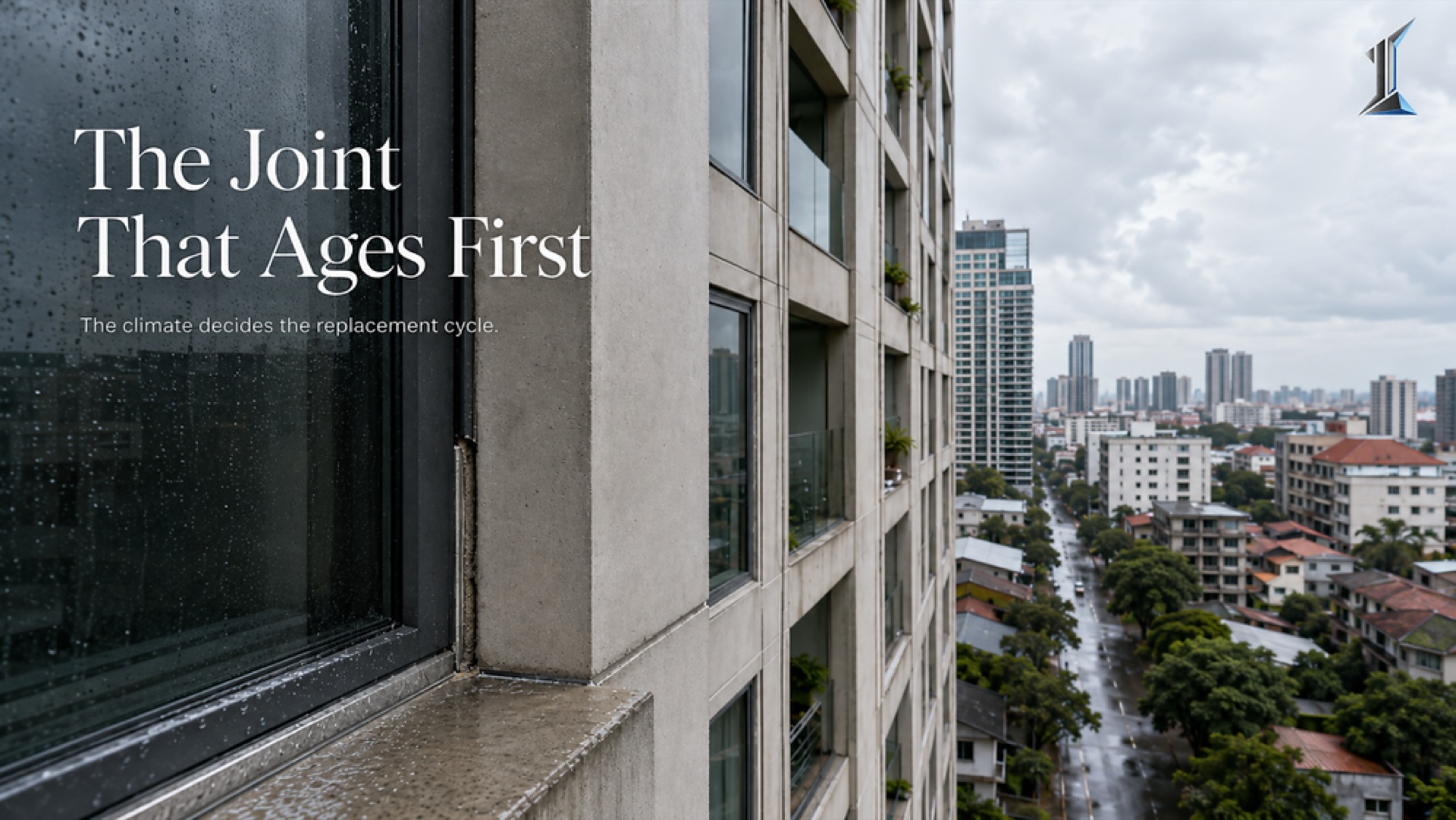
What the Sealant Spec Gets Wrong in Tropical Buildings
The product data sheet says 15 years. The Phnom Penh facade says 7. That gap between what the joint sealant specification promises and what a tropical climate delivers is where most building envelope failures begin. Understanding the chemistry, the joint geometry, and the access cost is what separates buildings that hold their condition through year fifteen from those that surprise their owners at year twelve.
Joint sealant is not a glamorous building component. It has no presence in the marketing brochure or the sales suite. It is the thin bead of material between a concrete panel and an aluminum frame, between a window surround and the wall, between a parapet cap and its substrate. Most owners do not know it exists until water appears on an interior ceiling that has no obvious reason to be wet.
What the Tropical Climate Does to a Joint
Sealant service life ratings come from testing conditions written for a different climate. They assume moderate UV exposure, seasonal rainfall, and temperature swings within a manageable range. Phnom Penh operates outside those assumptions on every dimension.
A south-facing facade panel here can reach surface temperatures above 60 degrees Celsius during afternoon sun. The same panel cools to near-ambient overnight. That daily thermal swing, repeated across 365 days, means a joint between dissimilar materials cycles continuously through expansion and compression. Silicone sealants with adequate UV stabilizers can handle this cycle. Sealants without them begin losing elasticity within two to three years. The joint goes from flexible to brittle, and brittle joints crack under load.
Cambodia receives roughly 1,400 millimeters of rain annually, concentrated between May and October with peak-intensity events. A joint that has already begun degrading under UV stress is being tested simultaneously by driving rain at pressure. The UV does the damage first. The monsoon finds the breach.
The Chemistry That Matters
The two chemistries used in most mid-rise exterior sealing are silicone and polyurethane. In a tropical climate, they are not interchangeable.
Silicone has an inorganic backbone, which gives it inherent resistance to UV degradation. A properly rated neutral-cure silicone, installed with the correct backing rod depth and surface preparation, maintains elasticity across a wide temperature range. For exposed exterior joints on concrete, glass, or aluminum facades in Phnom Penh, silicone is generally the right chemistry. Many modern construction specifications favor silicone for critical exterior joints because of its long-term weathering performance and movement capabilities, with some grades accommodating plus or minus 50 percent of joint width.
Polyurethane offers stronger initial adhesion to masonry and concrete and can be painted, which matters when the joint needs to read as part of a finished facade. The drawback in tropical exterior conditions is UV susceptibility. Surface temperatures on south-facing facades can exceed 60 degrees Celsius during afternoon sun, and this extreme heat causes rapid expansion of both substrates and sealants. A polyurethane joint on a west-facing facade without protective coatings will show surface chalking within two to four years. The service life the data sheet projected was measured in a different climate.
The most common specification error is not choosing the wrong chemistry. It is choosing an acceptable chemistry at an inadequate grade. A standard neutral-cure silicone rated for moderate UV exposure is not the same product as a high-performance grade with stabilizer additives rated for high solar irradiance. Both are labeled silicone sealant. On a Phnom Penh curtain wall, they do not perform the same.
Joint Geometry Is Half the Answer
Sealant chemistry determines the material's potential. Joint geometry determines whether that potential is realized.
A joint that is too narrow restricts the sealant's ability to flex. When the substrate moves, the joint attempts to accommodate that movement through a bead that cannot stretch far enough, causing the sealant to tear within itself. Improper joint sizing, either too narrow or too wide, can halve the sealant's lifespan. A joint that is too shallow provides insufficient bonding area, and the sealant separates from the panel edge at the interface. Both produce the same outcome: an open joint on a facade that faces the monsoon.
Facade sealant replacement begins with complete removal of existing sealant and backer rod. The backer rod, typically a closed-cell polyethylene foam insert, controls the sealant bead's depth-to-width ratio, which governs how much movement the joint can absorb without exceeding the sealant's elastic limit. Without the rod, or with it positioned at the wrong depth, even an expensive chemistry will fail early.
Joint geometry and surface preparation are the first decisions in the sequence. The sealant selection is the last one. Buildings that get this sequence right run replacement cycles that reach 10 to 12 years. Buildings that get it wrong discover the failure at year four or five, which is late enough to be invisible at the time of sale and early enough to be expensive.
Access Is Not Free
The maintenance conversation about sealant replacement focuses on the material cost. In a mid-rise building, the access cost is usually larger.
Replacing sealant on the third floor requires a ladder. Replacing sealant on the fourteenth floor in Phnom Penh requires a swing stage, a boom lift, or a rope-access crew. Rope-access technicians often reduce setup time on mid-rise exteriors, but any of these approaches carries a price structure and coordination requirement that is entirely separate from the cost of the material itself. A building designed without consideration of future facade access creates maintenance costs that surprise the owners' committee at year seven when the first replacement cycle arrives.
The access provision belongs in the maintenance reserve schedule, calculated at the design stage before the facade system is specified. A builder who asks what it costs to re-seal this facade at year seven, before the drawings are finalized, is asking the right question. Most specifications do not include the answer.
The Joint Sealant Replacement Cycle
A facade joint that reaches the end of its effective life and is not replaced on schedule begins a predictable sequence. Water enters through the failed seal and saturates the substrate. In masonry or concrete, repeated moisture cycling produces carbonation and, eventually, spalling. In facades with steel connections or anchor points, the moisture path creates a corrosion condition that is invisible from the exterior and expensive to remediate.
The condition of exterior joint sealants is often ignored, and repair or replacement costs are rarely included in the maintenance budget. The repair at year twelve is no longer the sealant. It is the sealant, the substrate damage, and whatever secondary moisture work the wall cavity requires. The capital cost bears no resemblance to what a scheduled replacement at year seven would have been. The maintenance reserve that was not funded for the access and material covers none of it.
That math closes at the specification stage, not at the remediation stage.
The joint is not the most visible element on a facade. Over a fifteen-year hold, it may be the most financially consequential one.
Owners who ask about the sealant chemistry, the joint geometry, and the access provision before they take title tend to find fewer surprises in the maintenance budget. The answers are in the drawings. They are rarely volunteered.
At Imajineer, this is part of the specification review that happens before the facade system is finalized. The conversation is available when it is useful.
footer class="PhCafd B6ltWa"