
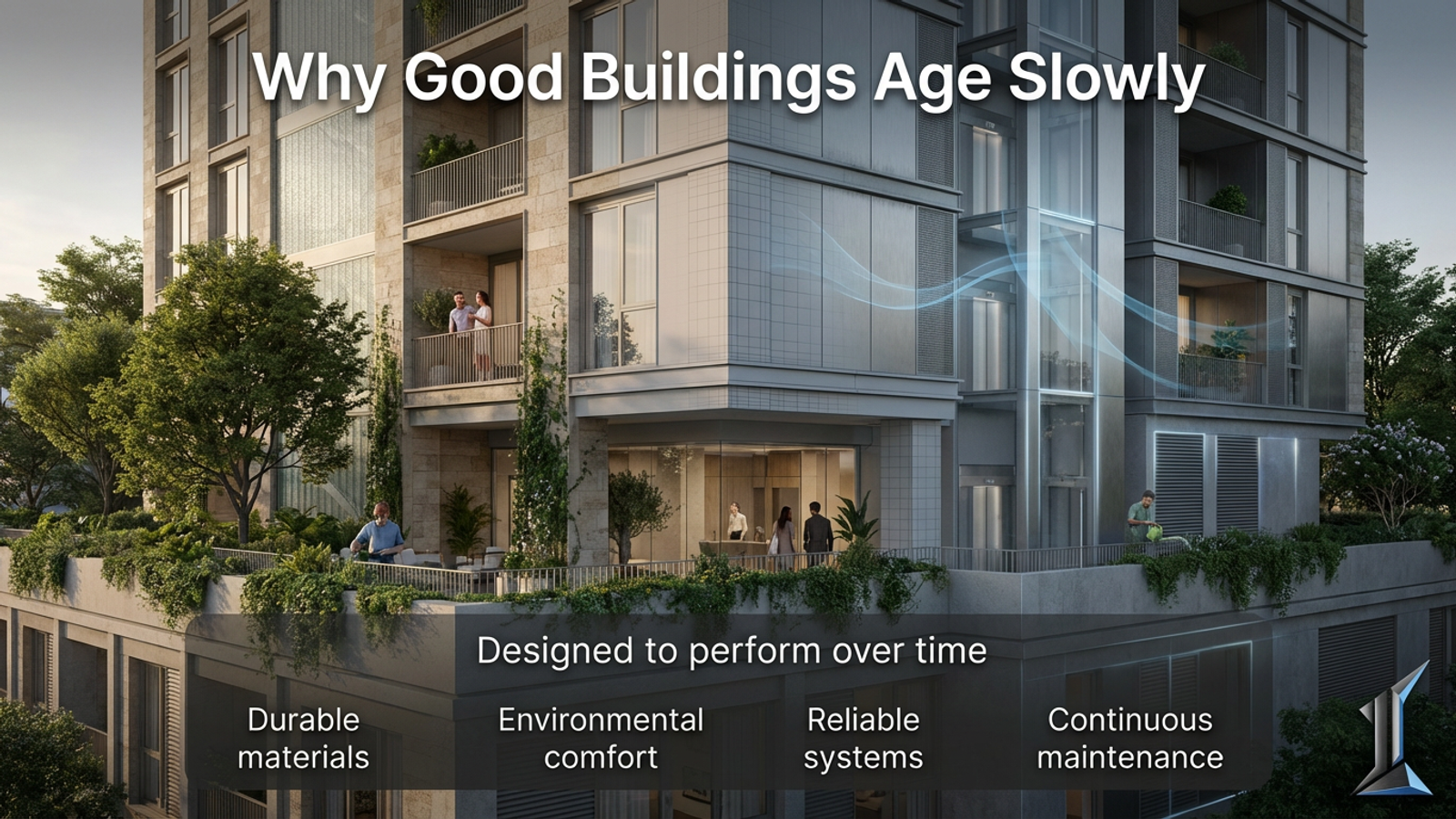
Why Good Buildings Age Slowly
Depreciation is not a law of nature; it is a set of design decisions made years before the first stain appears.
Stand two towers of the same 2012 vintage side by side in Phnom Penh and the contrast is stark: one reads as established, the other as exhausted. Neither outcome was luck. Buildings age at the speed their details allow, and those details were drawn a decade before the first stain appeared. For buyers, this makes weathering one of the few forms of depreciation that can be underwritten in advance, if you know where to look.
Detail is destiny
The tropics run an accelerated weathering program. Phnom Penh receives roughly 1,400 millimeters of rain a year, most of it in violent bursts between May and October, followed by months of hard ultraviolet exposure. Water finds every flat ledge and unprotected joint; algae and mold colonize any surface that stays damp; painted render chalks, streaks, and stains in vertical stripes below every windowsill that lacks a drip. The defenses are old technology, projecting drip edges, sloped copings, generous roof overhangs, ventilated rainscreen gaps, and facing materials such as tile, stone, or hard brick that wash clean in the rain rather than absorbing it. A painted facade in this climate wants recoating every 5 to 7 years, a six-figure cycle for a mid-size tower. Self-finished materials cost 10 to 20 percent more on day one and then largely stop costing anything at all.
Access is the second determinant, and the less discussed one. Facades that can be reached, davit points on the roof, maintenance balconies, walkable ledges, plant rooms with actual working clearance, get cleaned and inspected. Facades that require full scaffolding get deferred, and deferral is where aging compounds: a failed sealant joint admits water invisibly for years before the damage surfaces somewhere expensive. Buildings designed for inspection age slowly for the unglamorous reason that someone can afford to look at them.
The depreciation curve buyers ignore
Valuation practice tends to assume depreciation is roughly linear. Physically, it is a fork. Well-detailed buildings hold 85 to 90 percent of their presentation quality at year 15 and settle onto a plateau. Badly detailed ones look acceptable until about year 6, then slide fast as coatings, sealants, and building services fail in overlapping waves, each failure accelerating the next. Rents track appearance, because tenants tour with their eyes: a building that presents well at 15 years leases within touching distance of new stock, while its streaked contemporary discounts 15 to 20 percent and still moves slowly.
A building's future maintenance bill is written on its drawings. Most buyers never ask to read it.
The practical instruction is to underwrite details, not renders. Visit a 10-year-old project by the same developer and study the facade below the windows. Ask what the repaint cycle is, who pays for it, and whether the sinking fund has ever actually funded one. In a market where most stock competes on newness, the rare building designed to age slowly is the one still holding its price when newness runs out, and newness always runs out.