
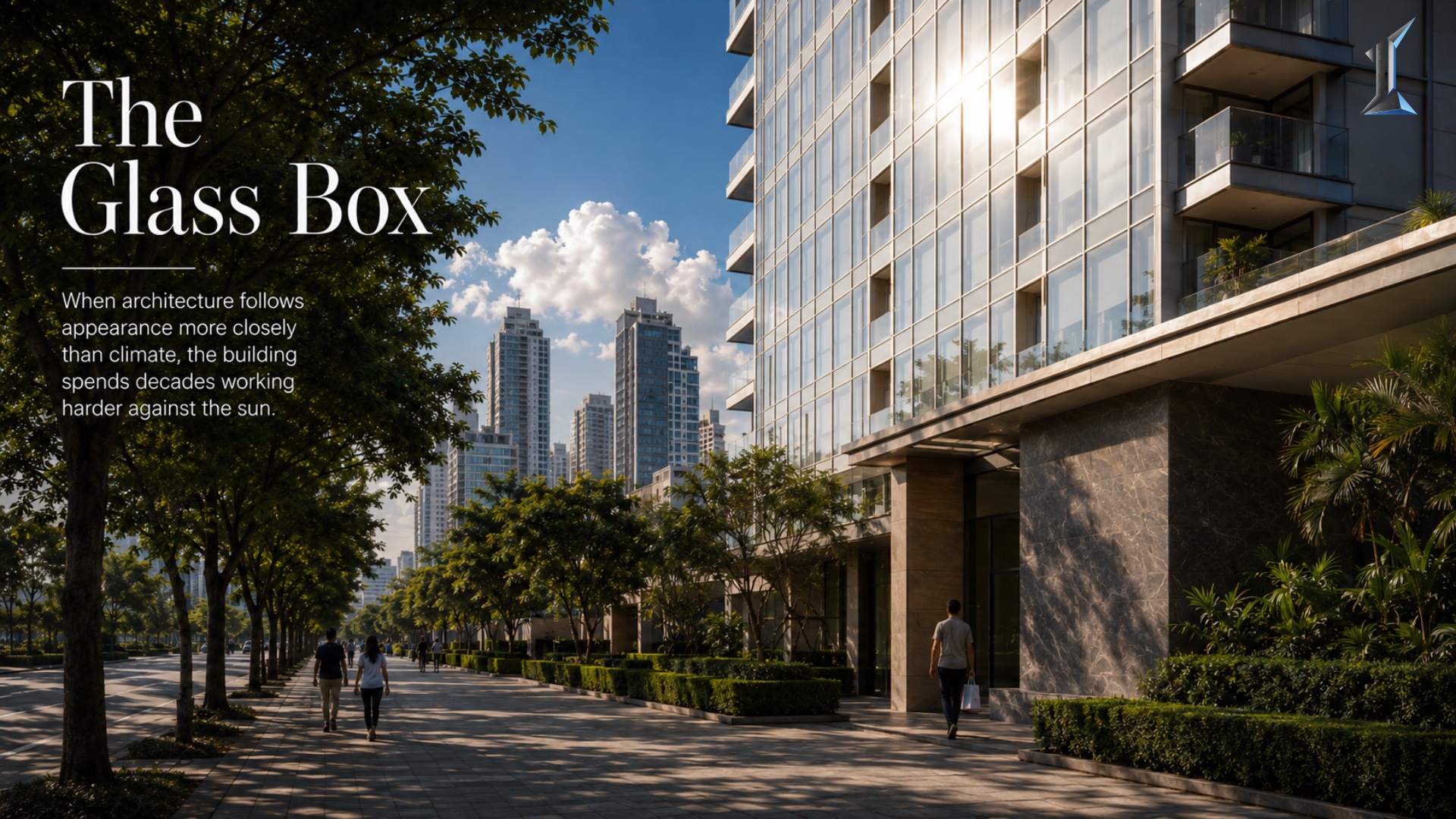
Why Generic Glass Boxes Fail in Cambodia's Climate
A generic glass box presents the same face to all four points of the compass. At 11.5 degrees north, that single decision is where the building starts to lose. The failure is not the glass. It is the shape behind the glass, a form imported from temperate cities that faces every direction the same way and hands the difference to the cooling plant. Here is why the typology fails in Cambodia's climate, and why the fix is upstream of the glazing.
A generic glass box in Phnom Penh usually presents the same face to all four points of the compass. The east elevation, the west, the north and the south carry the same curtain wall, the same glass, the same ratio of transparent surface to solid. At 11.5 degrees north of the equator, that one decision is where the building starts to lose.
The glass box is not a Cambodian idea. It arrived here fully formed, and it arrived from somewhere the sun behaves nothing like it does over the Mekong.
The typology was drawn for a colder sun
The all-glass curtain wall came out of temperate cities in the first half of the twentieth century. In those places the sun sits low in the southern sky for most of the year, and solar heat is a welcome guest for many months rather than an intruder. A fully glazed skin made sense there as a way to pull in light and warmth and to signal a certain kind of modernity.
That building was designed for a climate with a heating season. Phnom Penh has no heating season. It has a cooling season that runs twelve months and a sun that climbs almost to vertical.
When the typology travels to the tropics without changing its shape, it keeps the glass and loses the logic. The envelope that once collected warmth now collects a load the building has to fight every hour it is occupied.
Four facades, four different problems
At this latitude the sun does not stay in one quarter of the sky. It crosses nearly overhead. At solar noon the sun sits between roughly 55 degrees above the horizon in December and a full 90 degrees, directly overhead, twice a year in late April and mid-August.
That vertical midday sun is the part a building can actually handle. The harder hours are the ends of the day. In the early morning the sun strikes the east facade at a low angle, and in the late afternoon it strikes the west facade the same way, often below 30 degrees. Low sun arrives almost horizontally, under any roof edge, straight through vertical glass.
The north and south facades are the ones that behave. The high sun that reaches them at midday is the sun a modest overhang can turn away. A designer working with the climate would spend glass generously on the north and south and ration it hard on the east and west. The box spends it evenly, which means it overspends on exactly the two walls that can least afford it.
The overhang cannot save a shape it was never given
The usual answer is to add shading after the fact. A horizontal overhang, a fin, a screen. Shading is real and it works, but only against the sun it was sized for.
A horizontal overhang is efficient against high midday sun. It is nearly useless against the low east and west sun, which arrives beneath it. To control that sun you need vertical shading, deep reveals, a facade with real depth, or the simplest move of all, less glass facing east and west in the first place. None of these can be bolted onto a box after the massing is fixed. They are decisions about the shape of the building, and the shape is settled before the first pane is chosen.
This is the part the glass-box debate usually gets backward. The failure is not the specification of the glass. A better coating helps, and there is a separate discussion to be had about what the glazing number actually buys. The failure is upstream of the glass, in a form that faces every direction the same way and hands the difference to the mechanical system. Orientation costs nothing at the brief stage and cannot be undone once the foundation is poured.
Why the glass box keeps getting built
If the box performs badly, the reasonable question is why so much of it gets drawn. The answer has little to do with climate and everything to do with speed.
A glass box is quick to draw, quick to price, and quick to explain to a room of owners. Repeated glass reads as finished and current in a sales gallery. The building looks its best on the day it is handed over, photographed under a clean sky, before a single cooling season has run.
The performance arrives later, quietly, on the operating side, where a resident on the west face closes the blinds by two in the afternoon and the cooling plant works harder than the drawings promised. That gap between the handover photograph and the lived building is where value leaks. A unit that needs its blinds shut through the brightest part of every day is selling its light back to the sun, and the owner feels it long before the secondary market does.
None of this argues against glass. Glass, placed with intent and sized to the facade it sits on, is one of the finest things a building can offer. Light, view, a connection to the street. The argument is against glass applied uniformly, as a wrapper, by a shape that never asked which way it was facing. A building at 11.5 degrees north is a different problem from a building at 45, and the glass box answers the wrong one.
The generic glass box does not fail because of its glass. It fails because of the shape behind the glass, a shape decided before anyone specified a pane.
An owner who studies the massing before studying the finishes tends to spend less time explaining an afternoon cooling bill later. The work of orienting a building correctly rarely looks urgent against a launch date, and it is almost always the work that decides how the building performs in year fifteen.
At Imajineer, the direction a building faces is settled before the first elevation is drawn. The conversation is open when it is useful.