
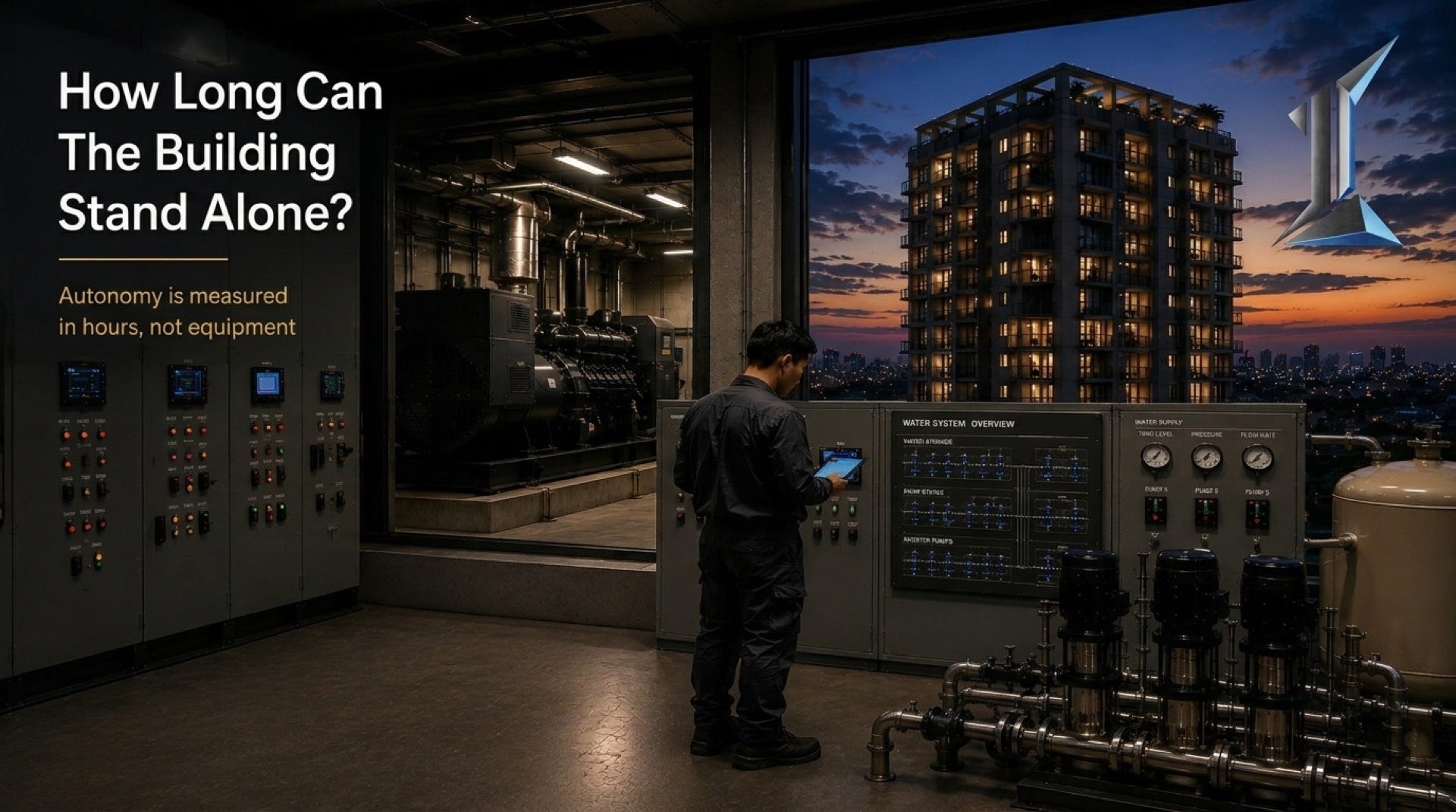
The Hours a Building Can Stand On Its Own
Most buildings carry about eight hours of diesel and a single day of water in reserve. That number, the hours a building can operate as a closed system, is the real measure of redundancy planning. This piece looks at what a generator is actually sized for, how many days of water a residential building should hold, and why a single generator with no spare is a backup with no backup of its own.
That duration is what redundancy planning is really about. Not the presence of a generator, not the headline size of the water tank, but the number of hours the building can operate as a closed system. Call it autonomy. It is the question almost no one asks at the brief stage, and it is the one that decides what a power cut feels like on the fourteenth floor.
The number that hides behind the word "backup"Backup is a noun people like because it sounds finished. A building has a generator, so the building is covered. The word does a lot of quiet work to end a conversation that should keep going.
Autonomy is the better frame because it is a duration, not an object. A generator with an eight-hour base tank and a water reserve of one day gives a building a real independence window measured in hours, and that window is shorter than most outages people actually plan around. The grid in a fast-growing tropical city carries its heaviest load in the dry season, when cooling demand climbs across the whole city at once. A building designed for that reality holds a reserve measured in days, not hours.
What the generator is actually sized forThe first question is not how large the generator is. It is what the generator is allowed to power.
Code-minimum design covers life safety only. That means fire pumps, emergency lighting, smoke control, and usually a single elevator in firefighter mode. For a 200-unit building, that load might sit around 150 kVA. The lights in the stairwell stay on, the fire systems work, and almost nothing else does. The apartments go dark, the air handling stops, and the other elevators sit still.
A building designed for the resident covers the full load. Every elevator, all corridor and unit power, the water pumps, the ventilation. For the same 200-unit building that is closer to 800 to 1,000 kVA, depending on how much cooling is centralized. The gap between 150 kVA and 1,000 kVA is not an engineering accident. It is a decision made at the brief, and it is usually made to protect the construction budget rather than the fifteenth year of occupancy.
There is a second number underneath the first. When the grid drops, an automatic transfer switch typically takes around ten seconds to bring the generator online. For those ten seconds the elevators stop wherever they are. A small uninterruptible power supply on the elevator controls and critical systems closes that gap to zero, so a resident between floors never feels the handoff. That piece costs very little and is left out constantly.
Water is the reserve people forgetPower gets the attention because the failure is visible. Water fails more quietly and matters just as much.
A reasonable design figure for residential demand is 150 to 200 liters per person per day. A 200-unit building housing roughly 500 people needs around 75,000 to 100,000 liters a day to function normally. A one-day reserve is the common minimum. A two to three day reserve is what separates a building that can absorb a municipal interruption from one that calls tankers and rations the upper floors by mid-afternoon.
Storage is only half of it. The pumps that move water from the ground tank to the roof are a single point of failure when there is only one. The discipline here is N plus one, a duty pump and a standby pump, so a failed unit does not empty the building. The same logic applies to the booster sets that hold pressure on the higher floors. A reserve of three days behind a single pump is still a one-failure building.
Redundancy is a topology, not a spare partThis is the reframing that changes how the whole subject reads. Redundancy is not the thing you add after the main system. It is the shape of the system itself.
Engineers describe it in plain notation. N means exactly enough capacity and no more. N plus one means one spare beyond the requirement. 2N means a full second set. Most residential buildings in this market land at N for power, which means one generator with no spare, which means the backup to the grid has no backup of its own. When that single generator does not start, and a generator that is never tested often does not start, the building has the same autonomy as a building with no generator at all.
The honest version of redundancy planning asks one question across both power and water. If the most important single piece fails on the worst possible day, what still runs? If the answer is nothing, the building does not have redundancy. It has equipment.
The part that only shows up in year sevenReserves degrade when no one is watching. Diesel left in a humid climate breaks down over months and needs periodic fuel polishing to stay usable. A generator that is not run under load monthly will quietly lose the ability to carry the load it was bought for. Water tanks that cannot be accessed and cleaned become a maintenance debt that compounds.
None of this is exotic. It is the maintenance reserve math that gets skipped at handover and paid back, with interest, when the first long outage finds the building unprepared. The cost of designing autonomy properly is visible on day one. The cost of skipping it is invisible until the day it is the only thing anyone is talking about.
The difference between a building that rides out a failure and one that is defined by it is set long before the failure arrives. It is set in the kVA the generator is allowed to carry, the days of water held in reserve, and the single decision to put a spare behind the part that matters most.
Owners who ask how many hours the building can stand on its own, before they sign, tend to spend far less time learning the answer the hard way. The work of designing that independence rarely looks urgent on the drawings, and it is usually the work that pays back the most over a holding period.
At Imajineer, autonomy is one of the numbers we set at the brief stage, before the first elevation is drawn, because it is far cheaper to design than to retrofit. The conversation is open when it is useful.