
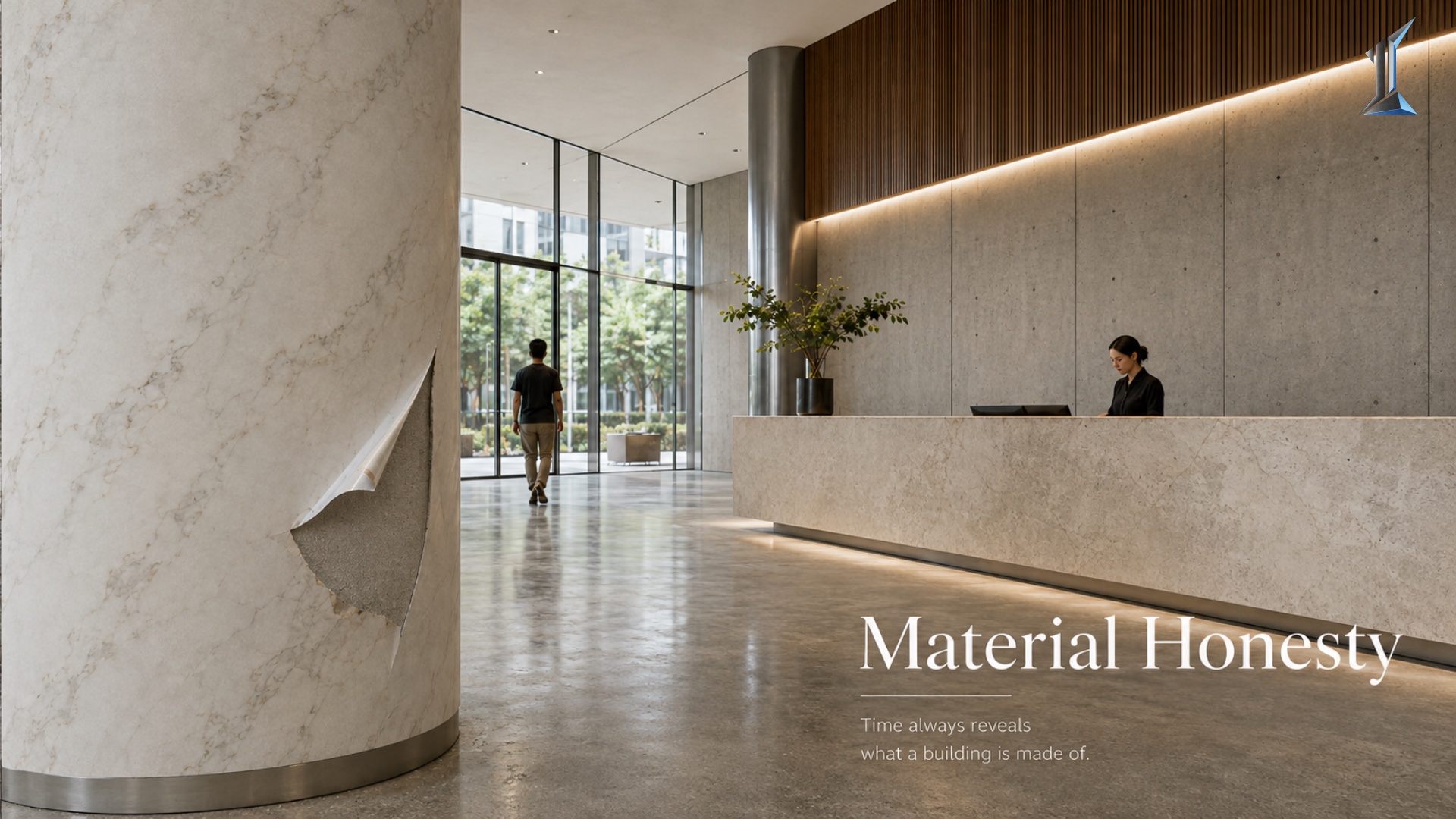
Material Honesty in Residential Architecture
Material honesty is the decision to let a material be what it is, rather than dress a cheaper one in the costume of a dearer one. In Phnom Penh's humidity, that decision ages in public. Honest materials fail by revealing more of themselves. Dishonest ones fail by revealing the substrate underneath. This is a look at why a wrapped column is never just one surface, and why finish honesty is a lifecycle decision rather than a budget one.
Pull a sheet of marble-look vinyl off a lobby column after eight years in Phnom Penh and you learn two things at once. The film peels away in a single curling sheet, and underneath it sits a gray fiberboard core that was never stone and never pretended to be, except on its outermost three millimeters. That edge, the honest gray line where the disguise ends, is the whole subject of this piece. Material honesty in residential architecture is the oldest argument in the discipline and the one most quietly set aside in fast-moving markets.
The question it asks is simple. Is the material what it appears to be, or is it something more accessible wearing the costume of something premium.
What material honesty actually means here
This is not a durability argument, and the two are worth separating early. A material can be modest and honest at the same time. Polished concrete is honest. It is concrete, it looks like concrete, and it ages like concrete. Painted plaster is honest. Raw timber is honest. Local terrazzo is honest. None of these sit at the premium tier, and all of them tell the truth about what they are.
Dishonesty is a specific move. It is the decision to make one material impersonate another. Thin film printed to read as Carrara. Vinyl planks embossed to read as oak. A sprayed coating textured to read as travertine. The dishonesty does not live in the modest price. It lives in the disguise.
The reason this matters for a building, rather than for a taste debate, is that the disguise carries information. A developer who wraps a structural column in marble film has made a decision about where the money goes and where the eye is meant to stop looking. The film tells you more than real marble would. Real marble tells you only that someone allocated for marble. The film tells you that someone wanted the reading of marble without the fact of it, and that instinct rarely stops at one column.
The tell is in how it ages
Honest materials and dishonest materials fail in opposite directions, and this is the center of the matter.
When natural stone chips, you see more stone. The color runs the full depth of the slab, so a knock on a corner reveals the same material underneath. It ages by becoming more itself. When a printed film chips or lifts, you see the lie. The gray substrate shows at the edge, the pattern stops abruptly, and the surface announces that it was a picture of a material rather than the material.
Phnom Penh sharpens this on a schedule. At 70 to 80 percent relative humidity through most of the year, with a monsoon that runs May to October, interior surfaces cycle between damp and dry constantly. That cycling is exactly what loosens adhesive-bonded films. Lower-grade marble-look sheets that might hold fifteen years in a dry climate begin swelling, yellowing, and delaminating far sooner here. Natural stone in the same lobby does nothing. It has no adhesive layer to fail and no printed skin to peel, and it holds one color the whole way through.
So the honest material and the dishonest one do not merely differ in year one. They diverge every year after, and the gap is legible to anyone walking through the door.
Why the disguise is never just one surface
Here is the second-order reading, and it is the one that matters to an owner.
A building is a sequence of decisions made under a budget. The choice to disguise a finish is almost never isolated. The same logic that wraps a column in film tends to also specify the thinnest acceptable glazing, the shallowest acceptable drainage falls, the most accessible acceptable riser. The visible dishonesty is a sample of an invisible pattern. You cannot inspect the plumbing behind the wall on a sales visit. You can inspect the lobby, and the lobby is quietly reporting how the plumbing was specified.
This is why an experienced eye reads finishes diagnostically rather than decoratively. A wrapped column reads as new for perhaps five years, which is conveniently just past the point where the first owner has moved on. The surface was chosen to perform for the sale, not for the fifteenth year. That single decision, repeated across a building, is the distance between an asset and a liability in a nice jacket.
The honesty premium is not a spending premium
The common misreading is that material honesty means allocating more. It does not. It means matching the claim to the fact.
An honestly finished polished concrete floor outlasts a marble-look vinyl at a lower installed value and a fraction of the replacement cycle. Manufactured stone veneer, which is honest about being manufactured stone, commonly carries warranties of twenty to fifty years. A printed film pretending to be stone carries no such life. The more accessible honest material beats the more accessible dishonest one on every axis that shows up across a holding period, including resale, where a surface that still reads as intact at year twelve supports a valuation that a peeling one cannot.
In a market where imported stone sits at the premium tier and local materials are more accessible, the discipline is not to disguise the accessible material as the premium one. It is to specify the accessible material honestly and detail it well. Well-laid local terrazzo tells the truth and keeps it. A film pretending to be marble tells a lie and loses it on a timetable.
The material was never the point. The decision to disguise it was.
Owners who learn to read a finish for what it admits, rather than what it imitates, tend to spend less time surprised at year seven. The surface that tells the truth in the showroom is usually attached to a building that tells the truth everywhere else, and that consistency holds more value than any single slab.
At Imajineer, this is one of the first things we specify and one of the last we compromise. A building should be what it appears to be, all the way down. The conversation is open when it is useful.