
Gaudí First Principles Design and the Tropical Brief
Antoni Gaudí finished only 17 buildings, yet a century after his death he is the most recognized architect of his era. The reason is not decoration. It is a method that solves structure honestly and lets climate and load shape the form. That discipline has direct lessons for how buildings should be designed in a tropical climate, where the glass box performs worst.
I first stood inside the Sagrada Familia in 1998. I went back in September 2025, before the final topping-out, and the building had not lost a single degree of its force. The second visit was stronger than the first. That is unusual. Most buildings reveal everything they have in the first sixty seconds and then settle into being a place you pass through. Gaudí built the opposite. He built a structure that keeps returning interest decades after the first encounter.
What the columns were actually doingThe standard reading of Gaudí is decorative. The curves, the color, the ceramic, the sense that nothing in the building is straight. That reading misses the engineering underneath. Gaudí was not avoiding straight lines for the look of it. He was following load.
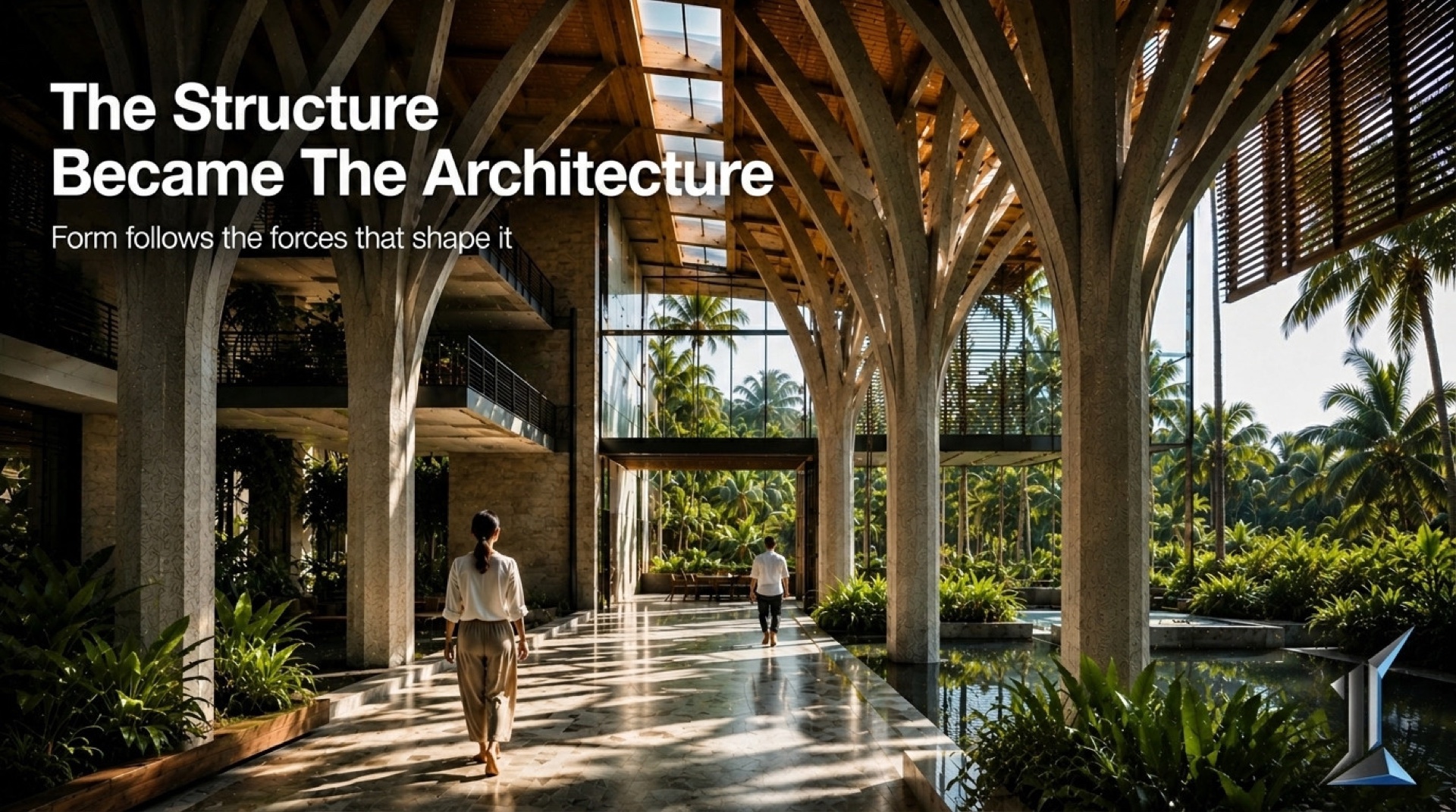
The branching columns of the Sagrada Familia nave are not sculpture pretending to be structure. They are structure shaped like the trees they resemble, splitting to carry weight down efficient paths the way a trunk divides into limbs. Gaudí modeled his forms with hanging chains and weighted strings, letting gravity draw the ideal compression curve, then inverting it. The shapes look organic because they were solved organically. The decoration and the structure are the same decision. That is the part most people never see, and it is the only part that matters.
The system was always firstA building that takes 143 years to finish has to be a system before it is an image. Gaudí knew he would not live to see it. He left behind a logic, a set of rules for how the forms generated themselves, so that architects who never met him could continue the work and stay true to it. The cathedral completing this year was designed by a man who has been dead for a hundred years, and it still reads as his.
This is the discipline I keep coming back to. The facade is the part the public photographs. The system is the part that has to survive the architect, the budget, the century. Gaudí's genius was not that his buildings are beautiful. It is that the beauty is a byproduct of solving the structure honestly. He did not apply ornament. He revealed it.
Why this matters in a climate like oursThere is a reason this lesson lands differently in Phnom Penh than it would in Barcelona. The default building in any fast-moving market is the glass box. It is quick to draw, quick to price, quick to sell. It also performs badly in a tropical climate, where a flat glazed envelope facing the wrong way turns into a heat trap, and where the absence of overhang and shading shows up as a cooling bill every month for forty years.
Gaudí's method points the other way. Start with the forces. Sun, wind, rain, gravity, the way water moves off a roof during monsoon. Let the building's shape answer those forces, and let the form follow from the answer. A roof shaped for rain is more interesting than a flat slab, and it also lasts longer. An overhang sized for the sun's angle gives a facade depth and shadow, and it also drops the cooling load. The organic shape and the performance gain are not in tension. They are the same move, made once.
The thing the glass boxes lostWhat the modern glass box gave up was not beauty in the abstract. It gave up the relationship between the building and the people standing inside it. Gaudí built spaces that produce an emotion you cannot quite name and cannot photograph. You feel it in the body before you understand it in the mind. That feeling is what architecture is for. It is the difference between a structure you occupy and a place you remember.
A building can be efficient and forgettable. Most are. The harder target, and the one worth aiming at, is a building that performs on the spreadsheet and still does something to you when you walk in. Those two goals are usually presented as a trade-off. Gaudí spent his life proving they are not.
The lesson of the centenary is not that we should all build cathedrals. It is that the architect who solves the structure honestly, who lets climate and load shape the form instead of fighting them, ends up with a building that is both better to live in and better to own. The decoration was never the point. The decision sequence behind it was.
Buildings designed this way ask more at the start and return more over the life of the asset. The work of solving form from first principles rarely looks urgent against a launch deadline, and it is almost always the work that decides whether the building is still admired in year fifteen.
At Imajineer, this is the standard we measure against when we draw the first elevation. The conversation is open when it is useful.
footer class="PhCafd B6ltWa"