
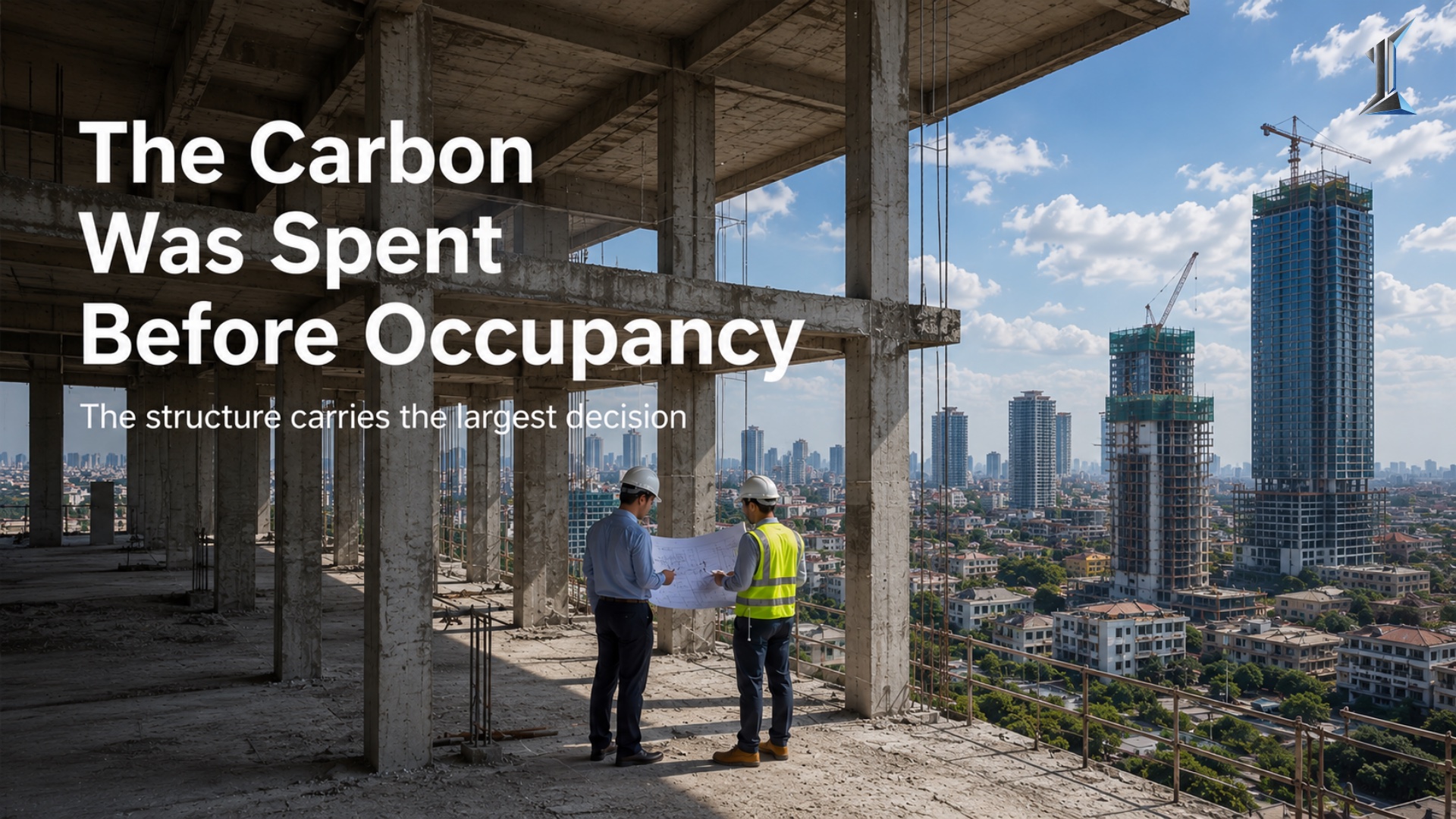
Embodied Carbon Comes Before Operational Carbon
A building emits much of its lifetime carbon before anyone moves in. Operational carbon can be improved for decades. Embodied carbon, the emissions locked into concrete and steel at construction, cannot. This is why embodied carbon now drives the green building conversation in concrete-heavy tropical markets, and why the decisions that govern it are made on the first structural drawings, not after handover.
The standard conversation about green buildings starts somewhere else. It starts with energy. Solar panels, efficient chillers, LED lighting, a building management system that trims the power bill. All of that matters, and all of it sits on the operational side of the ledger. The trouble is that the operational conversation begins after the most carbon-intensive decisions have already been locked in concrete.
Two kinds of carbon, only one of them reversible
Every building carries two carbon accounts. Operational carbon is the energy the building uses once it is running, the heating, cooling, ventilation, lighting, and hot water summed across the holding period. Embodied carbon is everything emitted to make the building exist in the first place, from extracting raw materials to manufacturing them, moving them to site, and assembling them into a structure.
Globally, buildings account for roughly 39 percent of energy-related carbon emissions. Around 28 percent of that total is operational, and the remaining 11 percent is embodied in materials and construction. Those proportions are shifting fast, and the direction is the part worth understanding.
Operational carbon is a flow. It can be improved every year the building stands. A chiller can be replaced, a solar array can be added, and the electricity grid itself decarbonizes over time as more renewable supply comes online. A building that looks energy-hungry today can be cleaner in year fifteen without anyone touching the structure.
Embodied carbon does none of that. It is a stock, spent in full at the moment of construction, and it cannot be recovered later. Operational carbon is a bill the building pays monthly. Embodied carbon is a bill settled once, before the keys exist, with no option to renegotiate.
Where the number actually sits
In a concrete building, the largest single source of embodied carbon is the structure itself. Cement is the reason. Cement production alone is responsible for roughly 8 percent of global carbon emissions, and producing one tonne of cement releases close to 0.8 to 0.9 tonnes of carbon dioxide.
The concentration inside the material is the detail most people miss. Portland cement usually makes up only 10 to 20 percent of a concrete mix by mass, yet it accounts for 75 to 90 percent of that concrete's carbon footprint. The gravel and sand are nearly free in carbon terms. The binder is where the emissions live.
Scale that up to a full building and the structure dominates. For a typical commercial structure, concrete alone can represent half or more of total embodied carbon. The frame holding the building up is also the frame holding most of its upfront emissions.
Why the timing is the whole argument
As operational carbon falls, embodied carbon becomes the larger problem by default. The forecasts converge on the same point. By the middle of the century, close to half of the carbon footprint of new construction is expected to come from embodied carbon, and over the next decade some analyses put embodied emissions at the majority of what new buildings produce.
The reason is mechanical, not ideological. Grids get cleaner, equipment gets more efficient, and the operational number drifts down on its own. The embodied number does not move after handover, so its share of the total rises as the other side shrinks. A building designed today will be judged in fifteen years against a standard where the carbon it already spent counts for more, not less.
This is the structural reframing. Certification frameworks like LEED and EDGE are increasingly measuring embodied carbon precisely because operational efficiency, on its own, no longer settles the question. The carbon you can still influence is the carbon you have not yet poured.
The Phnom Penh version of the problem
This market builds in concrete, in a climate that asks a lot of every structure. That makes the cement question local, not abstract. The two levers that matter both sit at the design stage, and both are gone once construction starts.
The first lever is using less structure. A building designed with structural efficiency in mind, spans sized correctly, slabs that are not thicker than they need to be, a frame that carries load without surplus, spends less embodied carbon simply by asking for less material. This is an architectural decision made on early drawings, not a procurement decision made later.
The second lever is the mix itself. Supplementary cementitious materials such as fly ash and slag replace a portion of the cement without weakening the concrete. A mix with 30 percent fly ash can cut the carbon of structural concrete from around 410 kilograms per cubic meter to about 290, a reduction of nearly a third in the building's single largest carbon line. The specification that allows this has to be written into the brief, because by the time the concrete arrives on a truck, the decision is already cast.
Neither lever costs more in any meaningful way. They cost attention, and they cost it early, at the one stage where attention is cheapest and most decisive.
The close
Embodied carbon is the part of a building's footprint that design decides and construction makes permanent. Operational carbon can be corrected for decades. The carbon poured into the foundation cannot.
An owner evaluating a building's sustainability is usually shown the energy story, because the energy story can still be improved and photographed. The harder and more honest question is what was already spent before the meter was installed, and that answer was written into the structural drawings long before anyone toured a show unit. The work that governs it rarely looks urgent, and it is the work that cannot be redone.
At Imajineer, embodied carbon is part of the first structural conversation, not a line added once the design is fixed. We treat the cement mix and the structural logic as carbon decisions because that is what they are. The conversation is available when it is useful.
footer class="PhCafd B6ltWa"