
What a Digital Twin for Building Operations Does
A digital twin can cut a building's HVAC energy by 15 to 20 percent, but the value is not created by the software. It is decided at the brief stage, through choices about protocols, sensor coverage, and whether the design model survives handover. This piece separates a working twin from an expensive dashboard, and explains when the operational model actually earns its cost in a tropical mid-rise.
A digital twin is not a 3D model. The distinction is a single data connection, and most buildings presented as smart do not have it. A true twin holds a live, two-way link between the physical building and its virtual copy. Sensors feed the model in near real time, and the model can be used to test a change before it is made on the actual equipment. A static drawing, however detailed, records what the building was meant to be. It says nothing about what the building is doing on a humid Tuesday in year seven.
What separates a twin from a model
The building information model, the BIM file, is the geometry. It carries the room definitions, the equipment locations, the design intent frozen at the moment construction documents were issued. That model is essential and it is also inert. Left alone, it ages into a historical record.
The twin is the BIM model with a nervous system attached. Real-time feeds from the building management system and from independent sensors flow into the geometry, so the model reflects current temperature, current chiller load, current pump behavior, current air quality. The defining feature is that the data moves in both directions. The physical building updates the model, and the model can be used to analyze and adjust the physical building. Without that loop, what is being sold is a screen.
What it does once the building is running
The building management system already exists in any serious mid-rise. It runs the alarms, switches the pumps, holds the setpoints. The twin sits above it and does the work a BMS was never built for.
It gives one holistic view across systems that normally report in isolation, so an inefficient chiller and a failing pump and a rising cooling load are read together rather than as three separate tickets. It runs simulation, which means a facility manager can model a setpoint change or an occupancy shift before committing to it. Most valuably, it supports predictive maintenance through three functions: detecting a fault as it forms, predicting the condition of a component before it fails, and scheduling the intervention while it is still cheap. Across reviewed deployments, HVAC-integrated twins land energy savings in the 15 to 20 percent range, and one campus-scale deployment reached 28 percent total energy savings while flagging a further 5 percent of cost the operator would otherwise have absorbed quietly.
Why most twins are dashboards
Here is the reframing the marketing avoids. The value of a twin does not live in the software. It lives in the data spine that was either built into the building or was not.
A twin retrofitted onto a building with a closed-protocol BMS, thin sensor coverage, and a BIM model that was abandoned at handover is a dashboard with good lighting. It can show what the few available sensors happen to report, and it can predict nothing it was never wired to see. The buildings where twins perform are the ones designed for open data protocols, instrumented with enough sensor density to make the model honest, and handed over with the design model intact rather than lost on a contractor's hard drive. The technology is downstream of those three decisions, and all three are made before the building opens.
The decision sits at the brief
In a fast market, the design intent of a building tends to evaporate at handover. The developer moves on, the facility team inherits a set of systems they did not specify, and the knowledge of how the building was meant to behave walks out the door with the design team.
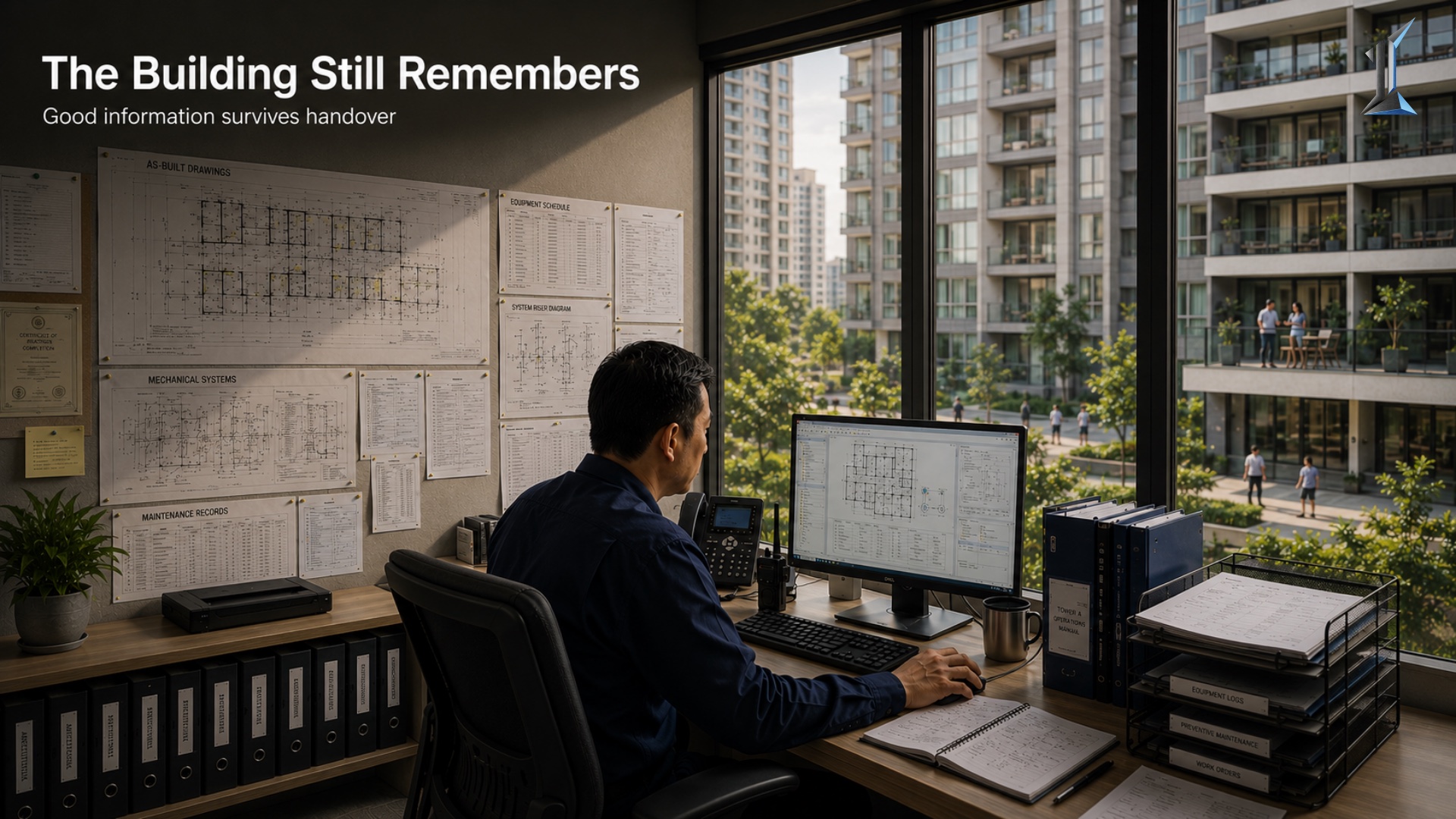
A twin is the institutional memory of a building's systems. It is the difference between a building that is still understood in year fifteen and one that has become a black box its own operators are afraid to touch. That is the fifteen-year test applied to operations rather than to finishes. The surfaces age visibly. The systems age invisibly, and a building without a live model of its own systems ages faster in the places no one is looking.
When the model earns its cost
The honest position is the same one that applies to certification and to green design generally. A twin built for the brochure is decoration, and decoration does not pay back. On a small building with simple systems, the operating cost it could defend is too low to justify the instrumentation and the platform. The math does not close, and the integrity is in saying so.
The math does close on a complex mid-rise with significant cooling load and a long ownership horizon. Reviewed ROI is strongest on buildings above roughly 100,000 square feet with layered HVAC, electrical, and mechanical systems, which is precisely the profile of the residential and mixed-use towers being built in this market. On that kind of asset, a 15 to 20 percent reduction in the largest operating line item, compounded across a fifteen-year hold, is not a technology expense. It is the most reliable defense of the long-horizon return the building has.
The twin does not make a building smart. It makes a building legible to the people responsible for it, which is a different and more durable thing.
The decision to make that legibility possible is an architectural decision, taken at the brief stage, about protocols and sensors and whether the design model survives the day the keys change hands.
At Imajineer, this is part of the conversation we have before the systems are specified, because by the time a building is operating, the chance to build a twin worth having has usually already passed. The conversation is available when it is useful.