
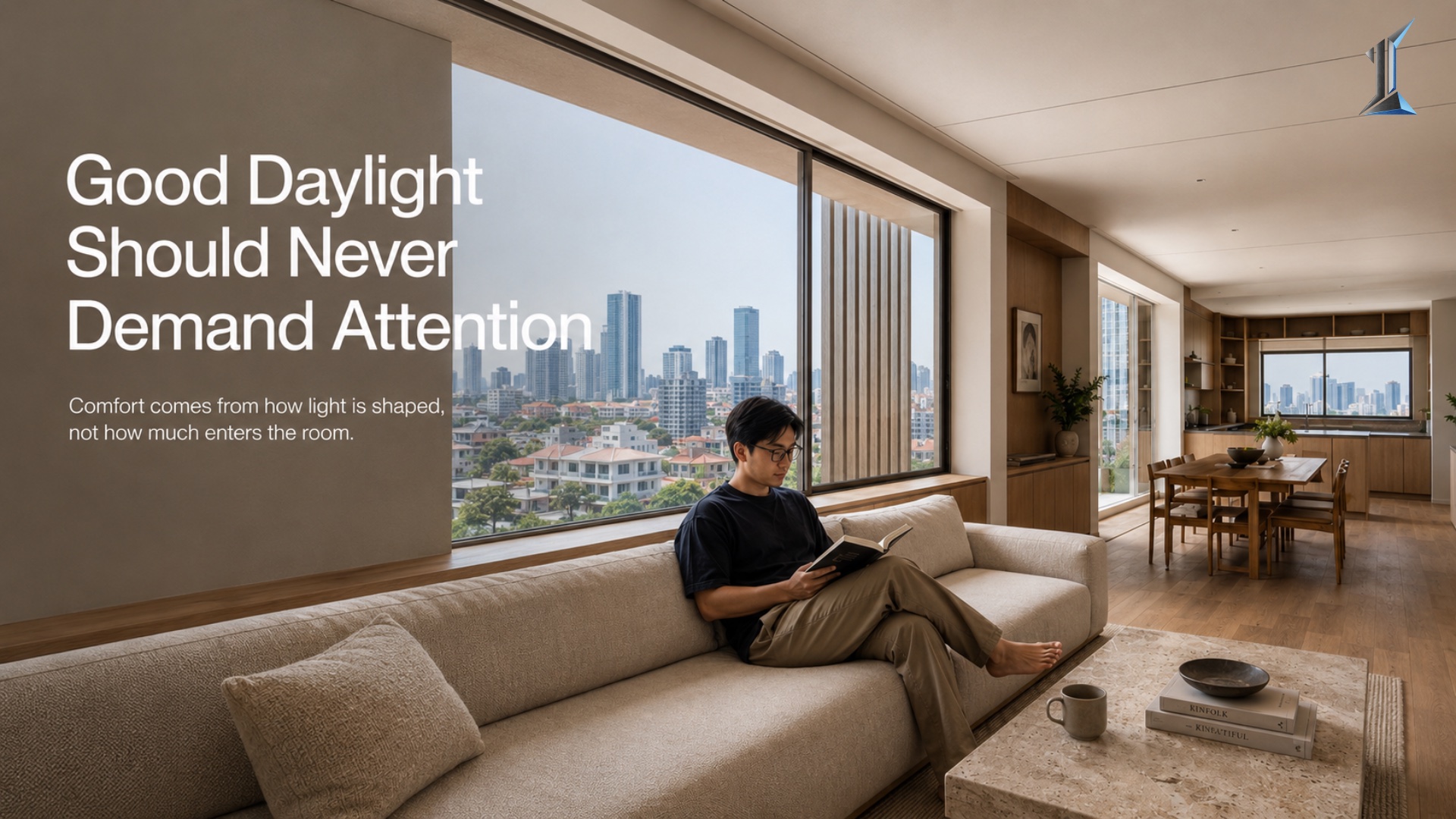
Daylight Quality Versus Daylight Quantity
A light meter reads quantity. It says nothing about glare, color fidelity, or the direction light enters, which are the properties a resident actually feels. In a tropical climate where the sky delivers more light than any interior can use, the design problem is editing that abundance into something comfortable. And every quality variable is locked at the schematic stage, before a single finish is chosen.
A living room can read 300 lux on a light meter and still be a room no one chooses to sit in. The meter registers the number the designer aimed for. The person on the sofa registers glare on the television, a wall that looks gray at three in the afternoon, and a corner that stays dim no matter how much sky is outside. This is the gap between daylight quantity and daylight quality, and it decides whether a room works.
Most residential design treats the two as the same thing. They are not, and the confusion produces rooms that pass every measurement and fail every resident.
The number everyone measures
Illuminance is the quantity metric. It counts how many lumens land on a surface, reported in lux. A living room target sits between 100 and 300 lux for general use, closer to 500 lux where someone actually reads. Outdoors on a clear day the figure is around 10,000 lux, and near the equator it climbs far past that by midday.
Illuminance is easy to measure, so it became the number the industry defends. Daylight standards extend it into metrics like spatial daylight autonomy, which asks whether a work plane clears 300 lux for at least half the occupied hours. These are useful numbers. They are also blind to almost everything that makes daylight pleasant.
A single sensor on a flat surface can report quantity and nothing else. It cannot report where the light came from, what color it renders, or whether it arrives as a soft wash or a hard blade across the floor. Those are the properties a resident feels, and none of them appear in the lux reading.
What the meter cannot see
Three things govern quality, and a light meter is deaf to all three.
The first is glare. Direct sun through unshaded glass produces contrast the eye cannot resolve, and the discomfort is measurable through daylight glare probability, a scale from zero to one that crosses into disturbing territory around 0.40. A room can hit its illuminance target and sit well above 0.40 at the same time. The number is right and the experience is punishing.
The second is color rendering. Natural daylight renders color near the top of the color rendering index, a scale to 100, and cheap tinted glazing can meet a lux target while dragging that figure below 80. Skin, wood, and fabric go flat and slightly wrong. The quantity is present. The fidelity is gone.
The third is direction. Light that enters high and reflects off a ceiling fills a room evenly. The same quantity entering low and direct rakes across the space, throwing long shadows and hot spots. Direction is the quality variable people feel most and name least. It is also the one thing a lamp added later can never repair.
Why daylight quality inverts in the tropics
In a cold northern climate, daylight design is a hunt for a scarce resource. Windows grow large to capture what little sky there is. The instinct to add glass makes sense when light is rare.
Phnom Penh sits near eleven degrees north of the equator, where the sky delivers more light than any interior can use. The tropical problem is not scarcity. It is abundance arriving with heat and glare attached. A wall of unshaded glass here does not solve a daylight problem. It creates three new ones: solar heat gain, glare, and a cooling bill that runs for the life of the building.
This is the reframing. In the tropics, daylight design is editing, not capture. The work is taking an oversupply of harsh, direct, heat-bearing light and turning it into a controlled, indirect, comfortable supply. Bigger windows move in the wrong direction. The better move is smaller and well-placed openings, deep reveals, generous overhangs, and interior surfaces that bounce light into the places a meter would never think to sit.
The decision that gets locked early
Every quality variable is set at schematic design, before a single finish is chosen. Window position decides direction. Room depth decides reach, and usable daylight from a side window travels only about two to two and a half times the height of the window head into the space. Past that line the room runs on electric light regardless of how bright the day is. Orientation and overhang decide whether the sun enters as a wash or a blade. Glazing spec decides color fidelity and how much heat rides in with the light.
None of these can be retrofitted. A resident can add a floor lamp and buy back quantity in an afternoon. No lamp restores direction, and no lamp removes a glare source that the window geometry built in. The quantity problem has a hardware store solution. The quality problem has only a design-stage solution, and the design stage closes early.
This is why daylight belongs in the first set of sketches, not in the lighting package near the end. By the time a project reaches finishes, the daylight quality of every room is already fixed. The team is no longer designing the light. It is living with the light the plan already chose.
The lux reading tells you a room has enough light. It tells you nothing about whether the light is any good.
Owners who look past the illuminance number and ask where the light comes from, how it renders, and whether it glares tend to end up in rooms that stay comfortable at every hour of the day. That question costs nothing at the sketch stage and cannot be answered once the walls are poured.
At Imajineer, daylight quality is worked out in the first plans, while the window is still a decision and not a constraint. The conversation is available when it is useful.