
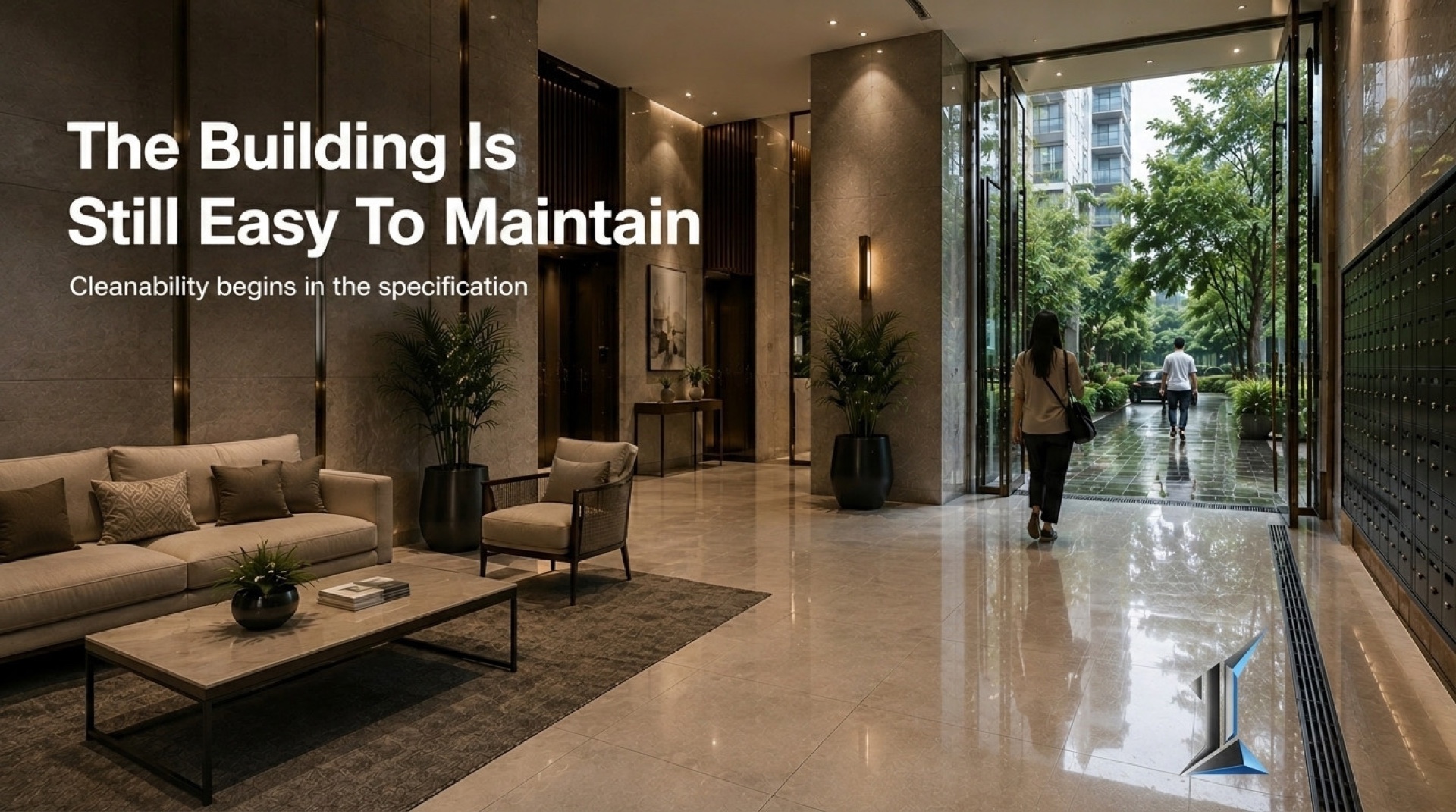
Cleanability Is Decided Before the First Tile Is Laid
Cleanability is usually treated as a housekeeping matter. It is a design decision, settled at the brief stage years before anyone picks up a cloth. Surface porosity, texture, and reachability decide whether a building looks dignified at year twelve or worn at year four. In Phnom Penh's humidity, a finish that cannot be cleaned does not stay neutral. It grows something, and the stain moves into the material.
Cleanability design is the part of the work that never appears in a render and quietly governs most of what the resident sees a decade later. It is usually treated as a housekeeping matter, something the building manager inherits. It is a specification decision, made at the brief stage, years before anyone picks up a cloth.
What a cleanable surface actually is
A cleanable surface is one that releases dirt faster than it absorbs it. Porosity is the whole argument. Polished porcelain has a water absorption rate below 0.5 percent, which is why a spill sits on top and wipes away. Many natural stones absorb between 1 and 10 percent of their weight in water, which means a spill does not sit on the surface. It enters it.
That single property decides the maintenance future of a floor before the floor exists. A surface that absorbs holds whatever it absorbs. In a residential lobby that sees a thousand wet shoe-soles a week during monsoon season, absorption is not a finish characteristic. It is a forecast.
Texture is the second variable. A matte, lightly textured tile hides daily dust and resists slip, which is why it gets specified for wet zones. The same texture traps grime in its valleys and needs mechanical scrubbing to clear, not a pass with a flat mop. Gloss reverses the trade. It cleans in one wipe and shows every smear, every footprint, every water spot under lobby downlighting. Neither is wrong. Choosing one without naming the cleaning method that comes with it is the error.
The tropical multiplier
Phnom Penh runs at relative humidity in the seventy to eighty percent range for much of the year, with a monsoon that delivers standing moisture for roughly six months. In that climate a surface does not simply get dirty. It grows something.
Mold, mildew, and algae are biological, not cosmetic. They need moisture, a porous foothold, and shade, and a poorly specified building offers all three. Silicone sealant around a shower tray or a window reveal has a realistic service life of seven to ten years in this climate before it discolors and lifts, and the black line that appears along a bathroom joint at year five is biological growth feeding on a surface that was never going to stay sealed.
This is why a finish that performs in a dry climate can fail here within a single rainy season. The material did not change. The air did. Cleanability in tropical buildings is a different specification than cleanability anywhere temperate, and a building designed without that distinction is designed for a climate it does not sit in.
The surfaces nobody can reach
A surface that cannot be reached cannot be cleaned, and reachability is set by the architect, not the janitor. High atrium glazing, the underside of a feature soffit, a light fixture recessed four meters above a stairwell, a facade detail that needs a cradle and a permit to access. Each of these is a cleaning event priced into the building's operating life at the moment it is drawn.
A glazed facade with no integrated cleaning access does not become low-maintenance. It becomes a recurring contract with a rope-access crew. A drainage channel with a 20 millimeter reveal that no brush head fits into does not stay clear. It silts, then it pools, then it stains the wall beneath it.
The discipline is simple to state and rarely applied. Every surface in the building should have a named cleaning method and a person who can physically reach it on the budget the building will actually have. If that sentence cannot be completed for a given detail, the detail is wrong.
The math the budget skips
Cleanability reads as a soft concern until it is priced. A lobby floor that needs weekly machine scrubbing instead of daily mopping is a labor line that compounds across a fifteen-year hold. A facade that requires specialist access twice a year is a fixed cost the developer never modeled, paid by the owners' association long after handover.
The cheaper finish is almost never cheaper. It is a deferred cost carrying a high interest rate, and the interest is paid in cleaning hours, replacement cycles, and the slow erosion of a building's reputation. A stain that cannot be removed becomes a stigma, and a stigma shows up in the secondary market as a discount nobody can quite explain. The unit did not change. The lobby did.
The decision that prevents all of this costs almost nothing at the brief stage and almost everything to reverse after the tile is grouted. This is the ordinary arithmetic of building design, and cleanability sits squarely inside it.
The stain in a year-ten lobby is rarely a cleaning failure. It is a specification made years earlier, finally showing its true cost.
Owners who ask how a surface will be maintained before they ask how it looks tend to spend less time apologizing for it later. The work of choosing a cleanable building is dull, it happens early, and it is the work that pays for the longest.
At Imajineer, the cleaning method for every surface is named before the finish is selected, because a building is judged on the humid Tuesday morning of year twelve, not the afternoon of handover. The conversation is available when it is useful.
footer class="PhCafd B6ltWa"